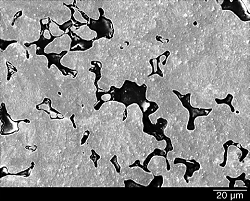
During sintering, metallurgical bonds form between powder particles. Strength, ductility, toughness, and electrical and thermal conductivities increase with increasing density. If different materials were blended together, interdiffusion could promote the formation of alloys and intermetallic phases. As a consequence of the density increase, size decreases. To meet desired tolerances, the compacted shape must be appropriately oversize. Not all porosity is removed; final press and sintered PM-products generally retain between 5 and 25% residual porosity. A typical pore structure in a press and sintered part is shown in the figure.
Higher densities together with greater homogenization are also achieved using high-temperature sintering, resulting in improved pore rounding and uniformity in alloying, which enables better heat treating response for the same alloy content. Most oxides are reduced during conventional sintering at 1150°C (2100°F), but oxides of certain elements like manganese and chromium are reduced at higher temperatures in a reducing atmosphere. These oxides degrade mechanical properties and interfere with the heat treatment response of the alloy. High-temperature sintering not only results in better mechanical properties but also extends the benefits in the heat treatment stage of the PM part.
For more information, click on the link below (subscription required). Then scroll to Figure 3.
Joseph W. Newkirk, Heat Treatment of Powder Metallurgy Steels, Heat Treating of Irons and Steels, Vol 4D, ASM Handbook, Edited By Jon L. Dossett, George E. Totten, ASM International, 2014, p 253-273, https://doi.org/10.31399/asm.hb.v04d.9781627081689.