Nanocrystals are a type of inorganic nanoparticle, defined as any material with at least one dimension smaller than 100 nanometers. While nanocrystals have been used to create new types of devices, from digital displays to medical diagnostics, ongoing challenges related to their synthesis, characterization, and combining different types of nanocrystals into a single material need to be addressed to create new materials for more complex applications.
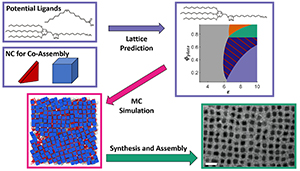
Now, a new paper in Science Advances, provides a blueprint for designing multifunctional materials using different combinations of nanocrystals. By bringing together theory, computational simulations, chemical synthesis, and assembly, researchers from the University of Pennsylvania and the University of Michigan demonstrate how an “inverse design” strategy can create unique materials from nanocrystals of varying compositions, sizes, and shapes. This work is an essential step towards establishing a blueprint for synthesizing new materials with unique properties.
One of the greatest challenges in the area of research is the sheer number and types of nanocrystals. With massive libraries of nanocrystals that have varying chemical formulas, sizes, and shapes, it’s difficult for researchers to know exactly where to start. Searching such a large chemical space efficiently and systematically requires a multidisciplinary approach, which was made possible by a long-running collaboration between Murray and Sharon Glotzer’s computational modeling group at the University of Michigan. Their collaboration aims to establish design rules and to create blueprints that bring together multiple properties simultaneously.
The approach described in this study is also universal in that these results can be applied to other types of materials with only minor adjustments. The researchers refer to their blueprint as an “inverse design” approach, one that relies on theory and observations to guide experiments to find nanocrystal combinations that imbue materials with new properties.
Researchers in the Murray lab are already busy using this new blueprint as they synthesize and experiment with new types of nanocrystals. Their long-term goal is to develop and use strategies that help materials scientists more efficiently delve into the rich space of nanocrystals in a way that enables them to create valuable and viable materials in the future.
For more information: University of Pennsylvania