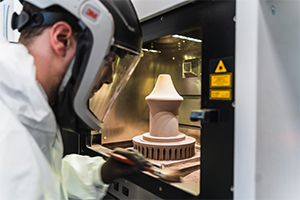
Spanish startups Pangea Aerospace and Aenium Engineering will have the exclusive capabilities to develop and industrialize advanced 3D printed propulsion systems in Europe made from an innovative copper-alloy material created by NASA called GRCop-42. Through this collaboration, Pangea will test its first GRCop-42-based aerospike rocket engines in the third quarter of 2021, expecting to radically transform space propulsion due to its higher efficiency, reusability, very low cost, and rapid manufacturing.
According to Pangea CEO, Adrià Argemi, the GRCop-42 alloy is one of the key solutions that allowed the company to solve the thermal challenges of aerospike nozzle rocket engines. Originally developed in 2019 as a feedstock for powder bed fusion printing by a NASA team of researchers, the material has demonstrated superior thermo-mechanical properties like no other in harsh environments. The metal powder has already been used by the space agency to produce and test near fully dense 3D printed parts such as combustion chamber liners and fuel injector faceplates.
By integrating additive manufacturing (AM), complex post-processing, and GRCop-42, Pangea and Aenium can now develop and commercialize propulsion systems for the European aerospace market, allowing more startups in the growing space industry access advanced propulsion solutions. Together, they have designed a 3D-printable aerospike nozzle rocket engine that should be up to 15% more efficient than those traditionally produced, allowing for a significant payload increase for any launch vehicle. Furthermore, thanks to the inherent advantages of 3D printing, the aerospike propulsion system can be additively manufactured in only two pieces, at a fraction of the cost, and intended to be reusable at least 10 times.
The agreement formalized between both companies ensures a breakthrough in engineering complex combustion devices and drives the analysis of different types of advanced superalloys so far untreated for the most demanding applications within the space sector. Although there are still quite a few milestones before the GRCop-42-based rocket engine takes off, we are eager to witness the first 3D-printed aerospike engine flying to space in a couple of years.
For more information: Pangea Aerospace