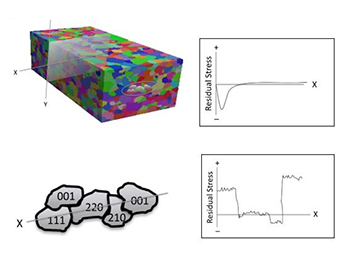
In the past ten to fifteen years, significant progress toward the understanding and management of residual stresses in metallic structure has been made under the auspices of numerous Metals Affordability Initiative (MAI) projects, Small Business Innovative Research (SBIR) projects, USAF program funded projects, and many others. In January 2020, the ASM International Technical Committee on Residual Stress formed a subcommittee on residual stress standards development, whose goal is to promote the development of standards and specifications for the measurement, modeling, understanding and management of residual stress.
This activity has resulted in a draft AMS standard, the purpose of which is to provide uniform methods for defining, quantifying, and classifying the residual stress in metallic structural alloy products and finished parts. Such quantification and classification may be required when residual stresses within components can impact further in-process distortion during machining or other methods, and when residual stresses within components can impact final component mechanical properties and performance.
The draft standard establishes residual stress classification criteria in terms of residual stress category and class. The currently defined residual stress categories are: 1) bulk residual stress, or near zero controlled residual stress; 2) joining residual stress, or tensile controlled residual stress; 3) engineered residual stress, or compressive controlled residual stress; and 4) targeted residual stress, or other residual stress not characterized as Category 1, 2, or 3.
Within each category, there are four residual stress classes which identify the range of stress needed to achieve a given level of quality assurance or product performance, as well as a fifth class for reporting purposes only. In general terms, the residual stress classes are: A) tightly controlled, B) moderately controlled, C) loosely controlled, D) uncontrolled, and E) report only. The standard provides process guidance with regard to product or part zoning and then residual stress assessment within a zone. Residual stress assessment within a zone can be accomplished either by measurement or modeling, or a combination of the two. Finally, the product or part is classified according to the assessed value of residual stress within the zone.
The standard was presented to the SAE Aerospace Metals and Engineering Committee (AMEC) in early July and is currently in ballot review. The contributors to the new standard were: Dale Ball, Lockheed Martin Aeronautics Co.; Brad Cowles, Cowles Consulting LLC; Chuck Babish, AFLCMC; Adrian DeWald, Hill Engineering LLC; Mike Hill, Hill Engineering LLC; Mark James, Howmet Aerospace; James Pineault, Proto Mfg. Inc.; Dave Furrer, Pratt & Whitney; and Thomas (TJ) Spradlin, AFRL.
************
For more information:
Dale Ball