Researchers from North Carolina State University, Raleigh, used airbrushing techniques to grow vertically aligned carbon nanofibers on several different metal substrates, opening the door for incorporating these nanofibers into gene delivery devices, sensors, batteries and other technologies.
“Because we’re using an airbrush, this technique could easily be incorporated into large-scale, high-throughput manufacturing processes,” says Anatoli Melechko, an adjunct associate professor of materials science and engineering. “In principle, you could cover an entire building with it.”
“It’s common to use nickel nanoparticles as catalysts to grow carbon nanofibers, and we were able to coat metal substrates with nickel nanoparticles using an airbrush,” says Joseph Tracy, associate professor of materials science and engineering. “Airbrushing gives us a fairly uniform coating of the substrate and it can be applied to a large area at room temperature in a short period of time.”

After applying the nickel nanoparticles, researchers airbrushed the substrate with a layer of silicon powder and heated the coated substrate to 600°C in a reactor filled with acetylene and ammonia gas. In the reactor, carbon nanofibers formed under the nickel nanoparticles and were held upright by a silicon-enriched coating. The finished product resembles a forest of nanofibers running perpendicular to the substrate. The researchers tested this technique successfully on aluminum, copper, and titanium substrates.
“Growing carbon nanofibers on a metal substrate means the interface between the two materials is highly conductive, which makes the product more useful as an electrode material for use in a range of potential applications,” says Mehmet Sarac, a Ph.D. student at NC State and lead author of the paper.
The paper, “Airbrushed Nickel Nanoparticles for Large-Area Growth of Vertically Aligned Carbon Nanofibers on Metal (Al, Cu, Ti) Surfaces,” was published online Sept. 9 in ACS Applied Materials & Interfaces. It was co-authored by NC State students Bryan Anderson, and Adedapo Oni; former NC State graduate students Ryan Pearce and Justin Railsback; former NC State postdoctoral researcher Ryan White; James LeBeau, an assistant professor of materials science and engineering; and Dale Hensley of Oak Ridge National Laboratory. The work was supported by the National Science Foundation, the Defense Threat Reduction Agency, the U.S. Department of Energy, and the Republic of Turkey’s Ministry of National Education.
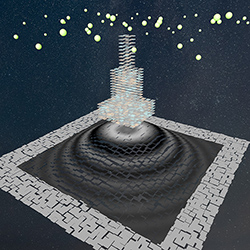
Image caption – Illustration of an airbrush is used to grow vertically aligned carbon nanofibers. Courtesy of Joseph Tracy.
More information:
North Carolina State University