Researchers led by a team from the University of Massachusetts Amherst recently announced a major theoretical and experimental breakthrough that allows scientists to predict, with an unprecedented precision, when a soft material will crack and fail. The findings, published in the Proceedings of the National Academy of Sciences, have immediate implications for the engineering and manufacture of a wide range of polymers.
It has proved devilishly complex to predict when a soft material, such as a gel or elastomer, will crack and fail. “It’s been a mystery,” says Alfred Crosby, professor of polymer science and engineering at UMass Amherst and one of the paper’s senior authors. Because scientists haven’t been able to accurately predict when a soft material will fail, designers typically over-engineer their products and recommend replacing them earlier rather than later, just to be safe. “But if we could predict exactly when a product would fail, and under what conditions,” says Crosby, “we could engineer materials in the most efficient way to meet those conditions.”
With a combination of highly precise chemistry, detailed and innovative computer modeling, and fine-grained experimental data, the group modified an older theory, called the Lake-Thomas Theory, with the help of a newer molecular model known as Real Elastic Network Theory (RENT). “As a result,” says Ipek Sacligil, graduate student in polymer science at UMass Amherst, and one of the paper’s co-lead authors, “using only the molecular ingredients, we can now accurately predict when a soft material will fail at both the molecular and product levels.”
For more information: UMass Amherst
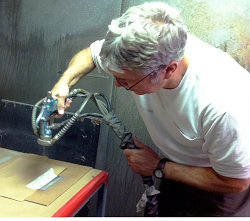
Image: UMass Amherst professor of polymer science and engineering Alfred Crosby