Imagine dropping a tennis ball onto a bedroom mattress. The tennis ball will bend the mattress a bit, but not permanently – pick the ball back up, and the mattress returns to its original position and strength. Scientists call this an elastic state.
On the other hand, if you drop something heavy – like a refrigerator – the force pushes the mattress into what scientists call a plastic state. The plastic state, in this sense, is not the same as the plastic milk jug in your refrigerator, but rather a permanent rearrangement of the atomic structure of a material. When you remove the refrigerator, the mattress will be compressed and, well, uncomfortable, to say the least.
But a material’s elastic-plastic shift concerns more than mattress comfort. Understanding what happens to a material at the atomic level when it transitions from elastic to plastic under high pressures could allow scientists to design stronger materials for spacecraft and nuclear fusion experiments.
Up to now, scientists have struggled to capture clear images of a material’s transformation into plasticity, leaving them in the dark about what exactly tiny atoms are doing when they decide to leave their cozy elastic state and venture into the plastic world.
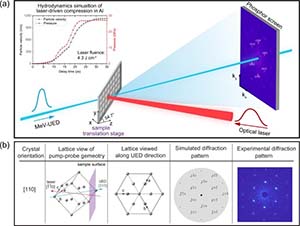
Scientists from the Department of Energy’s SLAC National Accelerator Laboratory have captured high-resolution images of a tiny aluminum single-crystal sample as it transitioned from elastic to plastic state. The images will allow scientists to predict how a material behaves as it undergoes plastic transformation within five trillionths of a second of the phenomena occurring.
They used a high-energy laser, which hammered the crystal hard enough to push it from elastic to plastic. As the laser generated shockwaves that compressed the crystal, scientists sent a high-energy electron beam through it with SLAC’s speedy “electron camera,” or Megaelectronvolt Ultrafast Electron Diffraction (MeV-UED) instrument. This electron beam scattered off aluminum nuclei and electrons in the crystal, allowing scientists to precisely measure its atomic structure. Scientists took multiple snapshots of the sample as the laser continued to compress it, and this string of images resulted in a sort of flip-book video – a stop-motion movie of the crystal’s dance into the plasticity.
More specifically, the high-resolution snapshots showed scientists when and how line defects appeared in the sample – the first sign that a material has been hit with a force too great to recover from.
As the high-energy laser struck the aluminum crystal sample, some rows of atoms in the crystal shifted out of place. Tracking these shifts – the line defects – using MeV-UED’s electron camera showed the crystal’s elastic-to-plastic journey. Researchers hope to apply their new understanding of plasticity to diverse scientific applications, such as strengthening materials that are used in high-temperature nuclear fusion experiments.
For more information: Nature Communications