Texas A&M University, College Station, announced in Acta Materialia that they have developed an artificial intelligence framework that enables the discovery of new shape memory alloys (SMAs). The framework was successfully used to identify both SMA chemistries and the associated thermomechanical processing steps that result in narrow transformation hysteresis and transformation range under an applied stress.
One of the obstacles to the deployment of shape memory alloys in solid-state actuation is the low efficiency and functional instability due to the transformation thermal hysteresis and large temperature ranges during martensitic phase transformation. Numerous studies have been conducted in an effort to minimize the thermal hysteresis and transformation temperature range of SMAs through ternary and quaternary alloying of known binary alloy systems, such as NiTi, and considerable success has been achieved. However, and crucially, the alloys discovered so far have failed to maintain a narrow hysteresis under applied stress.
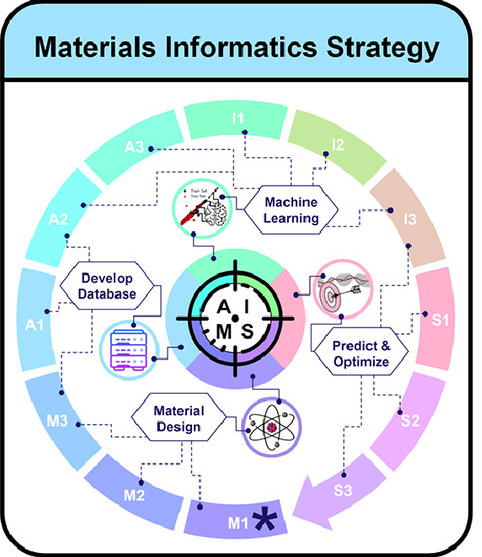
The major elements of the proposed workflow are described in detail and its materials-agnostic character makes it widely applicable to other alloy discovery challenges. Using this framework, and without relying on subsequent experimental exploratory analysis, an SMA composition, i.e. Ni32Ti47Cu21 (at.%), was predicted and confirmed to have the narrowest thermal hysteresis and transformation range under stress achieved thus far for a NiTi-based SMA. Furthermore, the alloy was shown to exhibit excellent cyclic stability and actuation strain. The methodology and the dataset introduced here can be extended to design novel SMAs with other target functions.
Read further here