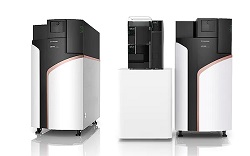
Shimadzu has released the LCMS-9050 quadrupole time-of-flight (Q-TOF) high-performance liquid chromatograph mass spectrometer. Shimadzu first entered the Q-TOF mass spectrometers (MS) market in 2018 with the release of the LCMS-9030. The LCMS-9050 is the successor model to the LCMS-9030 and is our most advanced model, cutting previous analysis times in half while providing data with high reliability.
MS are analytical instruments used to investigate the types and quantities of substances contained in samples by separating sample substances down to the atomic or molecular level and then measuring the mass and quantity of respective atoms/molecules.
The system consists of an injection unit that injects the sample, an ionization unit that ionizes the atoms/molecules, a mass separator unit that separates the ions by mass, a detection unit that detects the separated ions, and a data processing unit. Equipped with both quadrupole (Q) and time-of-flight (TOF) units for two types of mass separation, Q-TOF MS systems enable extremely accurate mass analysis.
Mainly used by pharmaceutical manufacturers, chemical companies, universities, and research institutions, they are used for cutting-edge research applications that require high sensitivity, high speed, and high mass resolving power in addition to high accuracy. However, though previous Q-TOF MS systems offered high accuracy, the complex design made it difficult to simultaneously achieve both high data reliability and short analysis times and required delicate handling and frequent mass calibration.
The LCMS-9050 can measure both positive and negative ions faster than competing models and in half the time of Shimadzu’s previous system. It enables simultaneous measurement of both positive and negative ions due to faster switching between mass separator voltages. Simultaneously measuring both positive and negative ions increases the amount of information obtained from each sample and increases data reliability, as required by pharmaceutical companies for developing new drugs and by chemical companies for developing new materials.
Optimizing the heater and temperature sensor layout reduces mass calibration frequency while providing high data reliability. Mass resolving power is also 1.5 times higher than the previous model. Systems can also be configured with a wide selection of Shimadzu instruments to optimize the system for specific applications.
Image – (Left) LCMS-9050 Quadrupole Time-of-Flight (Q-TOF)Mass Spectrometer. (Right) Example of LCMS-9050 Combined with Nexera Ultra High Performance Liquid Chromatograph.
For more information:
Shimadzu