 University of Birmingham, UK, researchers have developed Machine Learning (ML) techniques to enable the effective correlation of alloy characteristics.
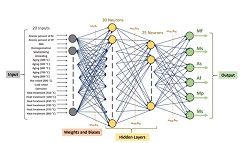
An ML Neural Network (NN) model is proposed to predict the transformation temperatures (TTs) of NiTiHf for a given combination of elemental composition and processing parameters within an acceptable confidence interval. The main challenge in NiTiHf TTs prediction is the high dimensional dependency of TTs to various parameters as well as not fully clear governing physics. Considerable experimental research was performed from 1995 to design the NiTiHf TTs which in turn paved the path to feed the ML algorithms which are now presenting an excellent approach for material design.
A thorough data set is constructed from both unpublished data and available literature and then analyzed to select twenty input parameters to feed the NN model. To model and forecast the TTs of NiTiHf with a wide range of TTs up to 800°C, a total of 173 data points are gathered, verified, and selected. The model’s overall determination factor (R2 )was 0.92, indicating the viability of the proposed NN model in showing the link between material composition, processing factors, and then defining the TTs of NiTiHf alloy. The effort additionally validates the generated results against existing data in the literature. The validation confirms the significance of the proposed model.