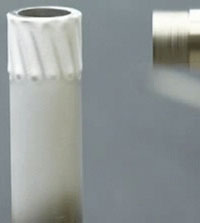
GE Global Research, Niskayuna, N.Y., is developing cold spray technology to build large parts and repair existing parts. The cold spray technique has the potential to scale up to build larger parts, with the only limitation being the size of the area over which metal powders can be applied. Since cold spray does not require heat, it allows a repaired part to be restored close to its original condition. In GE’s Oil and Gas business, researchers are exploring cold spray as an alternate way to repair or coat parts involved in oil and gas drilling and turbo machinery
According to Anteneh Kebbede, Manager of the Coating and Surface Technologies Lab at the GE Research Center, “In addition to being able to build new parts without welding or machining, what’s particularly exciting about cold spray as an innovative, 3D process is that it affords us the opportunity to restore parts using materials that blend in and mirror the properties of the original part itself. This extends the lifespan of parts by years, or possibly by decades, ultimately providing improved customer value.”
Spray technologies are particularly attractive for the production of large structures, which are challenging for today’s powder-bed additive manufacturing processes due to equipment size limitations. Cold spray-also known as 3D painting-demonstrates a unique marriage of materials, process, and product function which can, in the immediate future, transform repair processes for industrial and aircraft components such as rotors, blades, shafts, propellers, and gear boxes. Cold spray’s future benefits include extended product lifespan and reduced manufacturing time and material costs, all of which translate into significant customer benefits.