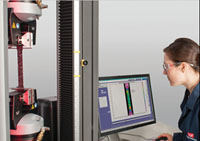
Instron, Norwood, Mass., introduces its Digital Image Correlation (DIC) system. This combination of hardware and software is designed to optically detect strain and displacement within a defined area on the surface of specimens or components exposed to loads. It enables users to visualize these characteristics in real-time on a computer screen, so that they can be traced over the entire duration of the test.
Image and calibration data is supplied by an Instron advanced video extensometer. The associated DIC software provides visualization and also saves the data at an adjustable rate of up to 50 Hz in the form of individual images for subsequent analysis in post-processing mode. The software runs independently of other programs, and leverages the graphical layout and tabbed style of Instron’s Bluehill Materials Testing Software – making the user interface familiar and easy to use.
The DIC technology provides several benefits compared to traditional strain measurement, including the documentation of discontinuous strain, localized necking, and more. DIC enables the detection of strains and displacements in cases where conventional extensometers are impractical, and enables the visualization of the side profile of flat bending or compression specimens. Finally, the DIC technology helps with standard compliance, as it identifies local strain that falls outside the standard gauge length of conventional extensometers.
The DIC software comes with a large number of standard functions. These include the generation of surface maps containing information on local axial and transverse strains and displacements, shear strain, and maximum and minimum normal strain. Further standard features include saving of processing parameters, graphical processing, and the capability of synchronization with Bluehill test data such as load, crosshead position, and more.