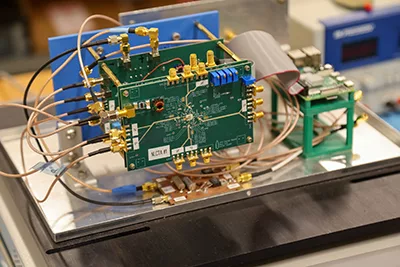
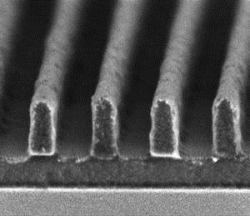
Nikhil Bajaj, an assistant professor of mechanical engineering and materials science at the University of Pittsburgh’s Swanson School of Engineering, studies nonlinear systems that shift behavior once a threshold is crossed—phenomena seen across disciplines in devices that rely on bifurcation to enhance sensitivity and performance. He has received a $649,684 National Science Foundation CAREER Award to rethink how these systems are designed, moving away from trial-and-error tuning toward an approach that starts with a desired behavior and engineers backward. His framework targets applications such as micro-electro-mechanical systems, including ultrasensitive gas leak detectors capable of identifying hazardous compounds at parts-per-billion levels, as well as energy harvesters and aerospace structures.
In a system with bifurcations, a quantitative change produces a qualitative one: a change in the value of the input changes the type of outcome. Once a certain threshold is met, the system doesn’t do more of what it was doing; it instead does something different. For example, a somewhat flexible column loaded with heavier and heavier weights will compress more and more, but once a specific load is placed on it, it will move in a different way, bulging out to one side or buckling.
Today, researchers can characterize these kinds of systems using a lot of trial and error and analogies to previous systems. “Say I’m building a car, and I want it to have 400 horsepower,” Bajaj said. If he didn’t know how to hit that number, he might take any engine and keep tweaking it, tightening something here, disconnecting a part there, until it worked. And horsepower is an easy case, a smooth dial you can turn up or down. The challenge multiplies when the goal is a threshold behavior: getting a system to switch into a new kind of motion at exactly the right input, and not a moment before.
“Designing in bifurcation behavior can feel a bit like working in the dark,” Bajaj said. Even so, the field has made remarkable progress. Across nonlinear systems, libraries of relationships have accumulated for many decades as researchers test inputs and observe outputs via theory and experiment. They’ve found that systems with bifurcations of all kinds (a wing vibrating erratically at speed, a material buckling under pressure, a neuron firing in the brain) seem to be governed by similar principles. The equations aren’t identical, but when systems engineers compare notes, they find meaningful similarities behind the different variables and outputs.
“We play the same mathematical games, just on different fields,” Bajaj said. At a nonlinear dynamics conference, he might have a specific engineering question on his mind. “But then I could run into someone doing the same thing on a biological system and I think, ‘I can use their method to apply to my problem.’”
The award also supports an education plan that spans the length of the pipeline. Bajaj will carry the science of nonlinear behavior (the buckling and the sudden shifts that turn up everywhere from bridges to neurons) to K–12 students and the public through science center and library exhibits, and will fold the same design methods into undergraduate and graduate coursework. A layered mentorship model reaching students at different stages aims to broaden participation in STEM, giving newcomers both a way in and a reason to stay.
Bajaj will use his CAREER Award to develop a unified computational framework for designing nonlinear systems from a desired behavior, rather than discovering their behavior through trial and error. “I want to pick all my parameters, all the knobs I can turn, so that it does the things I want it to do and not necessarily the things that are undesirable.” The framework is intentionally general; he will demonstrate the approaches on small and large scales, from MEMS gas sensors at the micrometer scale to flutter in aircraft wings.
For more information: U.S. National Science Foundation