The demands on vacuum-hardening technology have changed in recent decades. One of the most important considerations that must be met is the accomplishment of highest dimensional stability with optimal microstructural properties and minimal change of the surface of the workpieces.
Minimizing exposure to air during the heat treatment by reducing the quantity of oxygen in a heat treatment furnace, as with creating a vacuum, is an excellent method for preventing changes in surface appearance and chemical composition.
Suppliers of modern vacuum furnaces are further faced with new demands, such as increasing quenching speed to improve microstructural and mechanical properties by reducing grain size, and enhancing hardness and toughness and/or reducing distortion due to the hardening process. Furthermore, quality standards such as AMS 2750d or North American Die Casting Association (NADCA), which describe temperature homogeneity or quenching speeds and resulting and needed workpiece properties, had a significant effect on furnace design and process control.
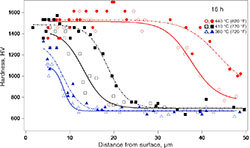
For more information, click on the link below (subscription required). Then scroll to Figure 14
R Schneider ; R. Mesquita ; H. Altena ; T. Müller ; P. Seemann,Processes and Furnace Equipment for Heat Treating of Tool Steels, ASM International, 2014, https://doi.org/10.31399/asm.hb.v04d.a0005958