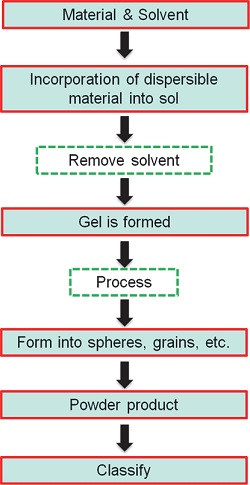
These are the five steps or stages to produce a powder by way of the sol-gel route.
Stage 1: The components are placed into solution. The liquid component is usually water or an alcohol. The solute is either an inorganic nitrate chloride or based on metal-organic compounds. These components allow thorough mixing of the species on the atomic scale, explaining the extremely homogeneous compositions that are obtained. This solution is often referred to as the precursor because it is the basis of the following steps that lead to the final powder.
Stage 2: The aforementioned solution, if it is not already a sol, will be converted to a sol. A sol is a colloidal dispersion (or a dispersed solid phase) that contains particles smaller than approximately 150 nm (0.15 μm, or 5.9 × 10⁻⁶ in.). The sol can be made stable by pH adjustment. Otherwise, the particles will grow to agglomerates that, in turn, may precipitate and thereby not enable the unique powder chemistries to be obtained.
Stage 3: The gelation step occurs next. This is essentially a step to remove most of the solvent (water or alcohol) so that a rigid body of well-defined chemistry is formed. The gel is still quite plastic or highly viscous. The processing variables are pH, temperature, and time.
Stage 4: The gel is shaped to the required morphology. This may be as spheres, fibers, or coatings. Thermal spray powders of spherical morphology are produced by a process called spray drying. These morphologies may also be produced by controlling the gelation stage in the conventional process.
Stage 5: The remaining solvent is removed, and the gel is calcined to form the final powder. This final temperature is significantly lower than the temperatures of conventional processing methods. For example, silica can be calcined from 600 to 1000 °C (1110 to 1830 °F).
Image – Steps for a sol-gel production route.
This information is from ASM Handbooks Online, Vol. 5A: Thermal Spray Technology, Coating Structures, Properties, and Materials. To find this information (subscription required), click on the link below and scroll down to Figure 6.
https://dl.asminternational.org/handbooks/edited-volume/12/chapter/133823/Feedstock-Material-Considerations-for-Thermal