Researchers at the US Department of Energy’s Oak Ridge National Laboratory (ORNL) in Tennessee are leveraging advanced manufacturing techniques, such as Hot Isostatic Pressing (HIP) Powder Metallurgy and Additive Manufacturing, to produce parts weighing over 4,500 kg. ORNL highlights the urgent need for these large-scale components across various sectors, including aerospace, defense, nuclear, oil, gas, renewables, and construction. This demand is particularly pressing in the US, where traditional manufacturing methods like casting and forging have declined and moved overseas, leading to supply-chain shortages.
Senior research scientists Jason Mayeur and Soumya Nag are hoping to add Wire Arc Additive Manufacturing (WAAM), hybrid manufacturing, in-situ monitoring and advanced computational modeling to HIP technology to create molds faster and more accurately whilst leveraging the PM technology American manufacturers may be more acquainted with.
“PM-HIP is a vital pathway for diversifying the supply chain for producing large-scale metal parts that are becoming more difficult to source via conventional means,” Mayeur explained. “The technology is of particular interest to the nuclear and hydroelectric industrial sectors, as well as the Department of Defense.”
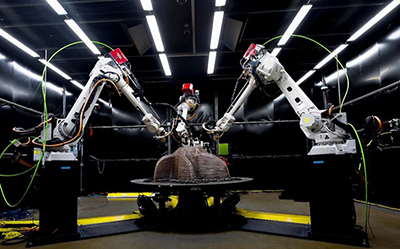
In contrast with traditional casting and forging techniques, PM-HIP involves fabricating pre-formed, hollow molds for each large-scale component and filling them with metal powder. Once the additively manufactured mold (aka a ‘can’ or ‘capsule’) receives an initial seal, any gas remaining inside is pumped out. Then, a more permanent hermetic seal is applied.
At this point, the capsule is heated and pressurized in prescribed cycles within a Hot Isostatic Press (essentially a pressurized furnace). Without melting, these cycles facilitate the consolidation of the metal powder into the required shape in a process exchange of heat and pressure known as solid-state bonding. When bonding is complete, acid leaching or machining is used to remove the exterior can, revealing the intended part.
Jason Mayeur works in the Deposition Science and Technology Group at ORNL, where he applies his knowledge in computational solid mechanics to manufacturing challenges. His two-decade research career began with the use of computational models to understand the relationships between materials microstructure and performance. He has since segued into the analysis of the structural material performance of metals and alloys.
In this arena, Mayeur develops theory, writes code to implement his theories, and then performs simulations of solids under various loading conditions to determine their suitability for use in a variety of applications. In short, Mayeur’s code can be used to improve the PM-HIP process, thus making it a more attractive alternative to traditional casting and forging.
Soumya Nag, Mayeur’s colleague at ORNL, works in the Materials Science and Technology Division, applying his own two decades of research experience in materials and manufacturing. Nag is a metallurgist with expertise in evaluating lightweight, high-temperature structural alloys fabricated via conventional and advanced manufacturing techniques.
“Jason is an expert in predictive modeling of deformation characteristics of Hot Isostatic Pressing canisters. I am more involved in the experimental side of things. Jason and I complement each other, and really, our two efforts are very much intertwined and critical toward the overall success of the task,” Nag said.
Nag’s research centers on the processing and materials science of HIP capsule fabrication, using various additive manufacturing techniques and assessing the quality of the resulting component parts.
“Additive Manufacturing offers unique design flexibility, which, combined with the reliability of PM-HIP, can pave the path toward precise manufacturing of large-scale, custom and complex, energy-related parts while also taking advantage of multi-material builds,” he explained.
Nag collaborates with Mayeur to design and perform experiments that characterize the metal powder material’s behavior and its mechanical properties in pursuit of a better, more accurate build while providing the necessary material property inputs for Mayeur’s computational models.
Mayeur’s work targets many technological challenges posed by the PM-HIP process, striving for quality and consistency in geometry to achieve dimensional accuracy at a very large scale. One challenge is shrinkage. During PM-HIP, the volume of metal powder within the can shrinks by approximately 30%, but not uniformly.
To address these inconsistencies, Mayeur’s computational models work to predict how the shrinkage occurs for different part geometries and capsule designs. This is an iterative process that occurs after initial capsule design, using the simulation results as a guide to modify the final design.
For more information: Oak Ridge National Laboratory (ORNL)
Image: This additively manufactured PM-HIP will be used to create an impeller for a hydropower impeller, demonstrating a new approach for creating large-scale clean energy components. (Courtesy Carlos Jones/ORNL, US DoE)