A research team at the University of Virginia School of Engineering and Applied Science, led by Assistant Professor Liheng Cai and his Ph.D. student Jinchang Zhu, has developed biomaterials with controlled mechanical properties that match various human tissues, potentially serving as the first building blocks for human-compatible organs printed on demand. Zhu highlighted this advancement as a significant leap compared to existing bioprinting technologies.
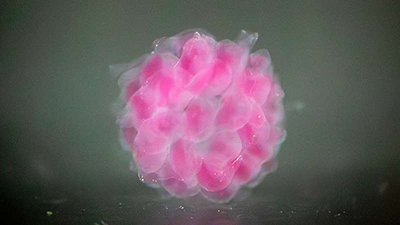
Their unique bioprinting method is called digital assembly of spherical particles. The DASP technique deposits particles of biomaterial in a supporting matrix, both of which are water-based, to build 3D structures that provide a suitable environment for the cells to grow. The assembly process is how “voxels,” the 3D version of pixels, construct 3D objects.
“Our new hydrogel particles represent the first functional voxel we have ever made,” Zhu said. “With precise control over mechanical properties, this voxel may serve as one of the basic building blocks for our future printing constructs.
“For example, with this level of control, we could print organoids, which are 3D cell-based models that function as human tissue, to study disease progression in the search for cures.”
The particles are polymer hydrogels engineered to mimic human tissue by tweaking the arrangement and chemical bonds of single-molecule monomers, which link together in chains to form networks.
Encapsuled within the particles are actual human cells.
Compared to other hydrogel bio-inks, Cai and Zhu’s are less toxic and more biocompatible for cells, they said. Their “double network” hydrogels—formed from two intertwined molecular networks—are mechanically strong, but highly tunable for mimicking the physical characteristics of human tissue.
Cai and Zhu first described their DASP technology in 2021. That work proved the concept of using biomaterial voxels as building blocks and, through lab experiments, demonstrated a DASP-printed material that functioned like a pancreas with glucose-stimulated insulin release.
But DASP 1.0 could only print brittle hydrogels with limited tunability. In their latest paper in Nature Communications, Cai and Zhu present DASP 2.0, which introduces the double-network hydrogel bio-inks formed using a “click chemistry” to rapidly cross-link, or bond, the molecular structures.
Part of what enabled this advancement was improvements to the team’s bioprinter. They designed a multichannel nozzle to mix the hydrogel components on demand. Premixing isn’t possible because the cross-linking occurs so fast, going from liquid droplets to an elastic water-swollen gel within 60 seconds.
In previous studies, the team determined that drop formation and rapid detachment from the nozzle are essential to mimic the mechanical properties—such as elasticity or stiffness—of the target human tissue.
DASP achieves this by depositing large droplets from a narrow and fast-moving nozzle into the matrix, immediately suspending them.
“We’ve now laid the foundation for voxelated bioprinting,” Cai said. “When fully realized, DASP’s applications will include artificial organ transplant, disease and tissue modeling, and screening candidates for new drugs. And it probably won’t stop there.”
For more information: Nature Communications
Image: Reminiscent of a raspberry, this voxelated hollow sphere made of a single layer of droplets was generated using digital assembly of spherical particles, or DASP, a 3D bioprinting process developed in assistant professor of materials science and engineering Liheng Cai’s lab. (Soft Biomatter Lab, UVA Engineering). Credit: University of Virginia School of Engineering and Applied Science/Liheng Cai