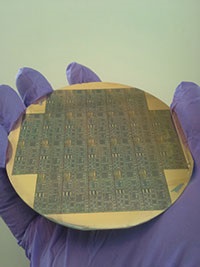
Engineering researchers at the University of Arkansas, Fayetteville, have designed integrated circuits on silicon–carbide wafers that can survive at temperatures greater than 660°F (350°C). The researchers worked with silicon carbide, which is able to withstand extremely high voltage and is a good thermal conductor, meaning it can operate at high temperatures without requiring extra equipment to remove heat.
Their work, funded by the National Science Foundation, will improve the functioning of processors, drivers, controllers, and other analog and digital circuits in power electronics, automobiles, and aerospace equipment – all of which must perform at high and often extreme temperatures.
The silicon-carbide wafer contains more 1000 individual circuits. “This ruggedness allows these circuits to be placed in locations where standard silicon-based parts can’t survive,” said Prof. Mantooth. “The circuit blocks we designed contributed to superior performance of signal processing, controllers and driver circuitry. We are extremely excited about the results so far.”
The research is critical because one-third of all power produced in the United States passes through some kind of power electronic converter or motor drive before it reaches the end user. Circuits developed by the University of Arkansas team will enable tight integration of control in the tough environmental conditions these applications demand. They will also improve electrical efficiency while simultaneously reducing the overall size and complexity of these systems.
The research was part of the National Science Foundation’s Building Innovation Capacity program, which is designed to partner university and industry research to build intellectual collaborations so that innovations flow from ideas to solid research results, company prototypes and products. The University of Arkansas and two Fayetteville technology firms, Ozark Integrated Circuits and Arkansas Power Electronics International, form the basis for this innovation ecosystem. Raytheon is also a key partner.
Ozark Integrated Circuits is commercializing the circuit technology. Arkansas Power Electronics International focuses on using the circuits in power applications.