Researchers at Purdue University, West Lafayette, Ind., have created the first modern complementary metal-oxide-semiconductor device in which germanium is the semiconductor instead of silicon. Germanium is being considered to replace silicon because it could enable the industry to make smaller transistors and more compact integrated circuits. Germanium is also said to have a higher mobility for electrons and electron holes, which enables ultra-fast circuits.
In new findings (“First Experimental Demonstration of Ge CMOS Circuits”), Purdue researchers show how to use germanium to produce two types of transistors needed for CMOS electronic devices. The material had previously been limited to “P-type” transistors. The findings show how to use the material also to make “N-type” transistors. Because both types of transistors are needed for CMOS circuits, it may now be possible for germanium to be applied in computers and electronics.
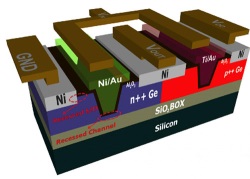
The material has properties that make it difficult to create an N-type contact with low electrical resistance for good current flow. However, the germanium can be doped with impurities that alter its properties. The areas containing the most impurities have the lowest resistance. The researchers showed how to etch away the top layer of germanium, exposing the most heavily doped portion, which provides good contact.
The etching creates recessed channels, which serve as gates needed for CMOS transistors to switch on and off. Research shows the fundamental part of the circuit, called the inverter, is the best-performing non-silicon inverter demonstrated so far.