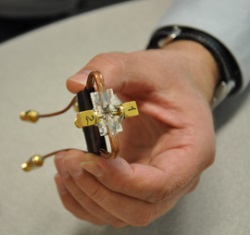
Physics World, the magazine of the Institute of Physics, U.K., has selected Magnonic Holographic Memory as one of the “2014 Ten Breakthroughs of the Year.” It is a new type of holographic memory device based on the interference of spin waves. It was developed by researchers at the University of California Riverside’s Bourns College of Engineering, in collaboration with researchers from the Russian Academy of Sciences.
Alexander Khitun and Frederick Gertz at the University of California Riverside, and A. Kozhevnikov and Y. Filimonov of the Kotelnikov Institute of Radioengineering and Electronics in Russia, developed the device. The work is available online at http://ieeexplore.ieee.org/xpls/abs_all.jsp?arnumber=6922543&tag=1.
The spin waves used in Prof. Khitun and colleagues’ magnetic holography device have much shorter wavelengths than visible light, and could therefore be used to store data at higher densities. Experimental results show it is feasible to apply holographic techniques developed in optics to magnetic structures to create a magnonic holographic memory device. This approach combines the advantages of magnetic data storage with spin-wave-based information transfer.
Dr. Khitun has been working for more than nine years to develop logic device exploiting spin waves. Most of his initial research was focused on the development of spin-wave-based logic circuits similar to those in computers. A critical moment occurred last year when the researchers changed direction towards holographic devices, which are aimed not to replace but to complement CMOS in special task data processing.
“The results open a new field of research, which may have tremendous impact on the development of new logic and memory devices,” he says. Researchers are now focused on the demonstration of pattern recognition by using the developed magnonic holographic devices.
The breakthroughs were chosen by a panel of six Physics World editors and reporters. Criteria included the fundamental importance of research, significant advance in knowledge, strong connection between theory and experiment; and general interest to all physicists.
This research is supported in part by the FAME Center, one of six centers of STARnet, a Semiconductor Research Corporation program sponsored by MARCO and DARPA, and by the National Science Foundation under the NEB2020 Grant ECCS-1124714.