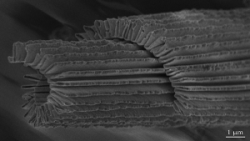
The Technical University of Munich (TUM) announces that its researchers have printed razor-thin polymer electrodes with improved electrical properties. To manufacture the components on an industrial scale, semiconducting or insulating layers – each a thousand times thinner than a human hair – must be printed onto a carrier film in a predefined order.
“This is a highly complex process, whose details need to be fully understood to allow custom-tailored applications,” explains Prof. Peter Müller-Buschbaum of the Chair of Functional Materials at TU München. A further challenge is the contact between flexible conducting layers. Hitherto electronic contacts made of crystalline indium tin oxide were frequently used. However, this construction has numerous drawbacks: The oxide is more brittle than the polymer layers over them, which limits the flexibility of the cells. Furthermore, the manufacturing process also consumes much energy. Finally, indium is a rare element that exists only in very limited quantities.
A few months ago, researchers from the Lawrence Berkeley National Laboratory in California for the first time succeeded in observing the cross-linking of polymer molecules in the active layer of an organic solar cell during the printing process. In collaboration with their colleagues in California, Prof. Müller-Buschbaum’s team took advantage of this technology to improve the characteristics of the polymer electronic elements.
The TUM research team is now, together with its U.S. colleagues, publishing the results in the trade journal Advanced Materials (“The Crystallization of PEDOT: PSS Polymeric Electrodes Probed In Situ during Printing”).
http://www.tum.de/en/about-tum/news/press-releases/short/article/32446/