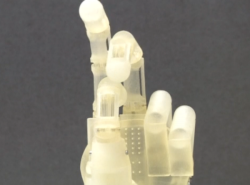
Saarland University, Germany, reports that its engineers have developed a bionic hand that is based on bundled nitinol wires activated by electricity. By running a current through the metal, the wires can heat up and be made to flex. The research team harnessed this property and built the wires into a plastic arm to work as tiny muscles that can tug and pull individual fingers to open and close.
“This enables us to build particularly lightweight systems, and the fact that they are wires enables us to use them as artificial muscles, or artificial tendons,” explains Prof. Stefan Seelecke.
In the case of the bionic hand, an electrical charge transforms its lattice structure, causing it to contract like a muscle. When the charge is turned off, the wire returns to its original shape as it cools.
Engineer Filomena Simone, a PhD student who co-developed the prototype bionic hand, says the team copied the structure of muscles in the human body by grouping the fine wires into bundles to mimic muscle fibers. This bundling of wires presents a greater surface area through which heat can be dissipated, allowing them to undergo rapid contractions and extensions, much like real human muscles.
“The movement of the hand is done by the wire. This wire, when activated, will contract. And we are able to exploit this contraction to make the fingers move. And we can move each phalanx independently,” Ms. Simone said. A single semiconductor chip controls the shape of the smart wires, which use electrical resistance to function. This means no external sensors are needed, as the material itself has sensory properties allowing the hand to perform extremely precise movements.
While the technology is still in the early stages of development, the team is hopeful that the technology could eventually be used to build prosthetic limbs that function and feel more natural.
http://www.reuters.com/article/2015/07/22/us-germany-bionic-hand-idUSKCN0PW1N820150722
http://www.imsl.uni-saarland.de/en/