During tempering, the combination of material properties such as hardness, toughness, and corrosion resistance, as well as residual stresses, can be adjusted within a wide range. Very low (<300°F) tempering temperatures are uncommon, as they result in very low impact toughness and high internal stresses.
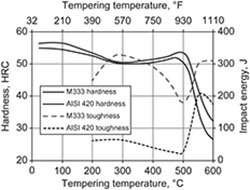
With increased tempering temperatures, toughness properties can be improved significantly with only limited loss in hardness, as shown in the graph. The precise behavior strongly depends on the uniformity of the microstructure and on chemical composition, with advantages shown by nitrogen-alloyed lower-carbon grades. Typical tempering temperatures for small and simple-shaped tools vary between 390°and 750°F. In the case of large and complex dies, such tempering temperatures can still lead to very high internal stresses, resulting in early tool failure despite good impact toughness.
Volume 4D, Heat Treating of Irons and Steels -> Tool Steels -> Heat Treating of Mold Steels and Corrosion-Resistant Tool Steels -> Recommended Heat Treating Practices