Researchers at Lund University, Sweden, discovered how iron-based dyes work on a molecular level in solar cells. Their findings will accelerate the development of inexpensive and environmentally friendly solar cells. The goal is to be able to use iron-based dyes in solar cells in the future.
By using iron instead of other more expensive and rare metals, solar cell and light catcher production will become less expensive and more environmentally friendly. The demand for solar cells is therefore expected to significantly increase.
“In this new study, we explain how iron-based dyes work on a molecular level. That way we are able to further improve these iron complexes so that they become even better at absorbing and storing solar energy,” says senior lecturer Petter Persson.
For decades, researchers have tried unsuccessfully to develop iron-based dyes. A crucial reason for the difficulty is that achieving the right electronic properties in dyes based on iron is much harder compared to other metals. But where others have failed, Lund researchers have succeeded. “There is a lot of international interest in our research. Research groups in other parts of the world are keen to test the new dyes in other areas of application,” says Persson.
It will probably take a few years before iron dyes are used commercially in the production of solar cells and light catchers. However, Persson is still surprised at the rapid development: “It is difficult to develop new materials for solar energy conversion. For once, the process has been unusually quick and we have made several important breakthroughs in just a few years.”
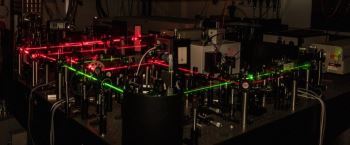
Image caption — Laser lab where part of the research work was conducted. Courtesy of J. Uhlig/Lund University.