Rice University, Houston, announces that its researchers have determined that fibers made of carbon nanotubes configured as wireless antennas can be as good as copper antennas but 20 times lighter.
The Rice team and colleagues at the National Institute of Standards and Technology (NIST) developed a metric they call “specific radiation efficiency” to judge how well nanotube fibers radiate signals at the common wireless communication frequencies of 1 and 2.4 gigahertz, and compared their results with standard copper antennas. They made thread comprising from eight to 128 fibers that are about as thin as a human hair and cut to the same length, to test on a custom rig that made straightforward comparisons with copper practical.
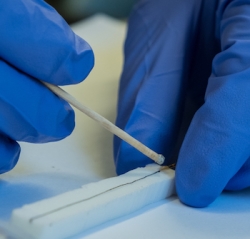
“Antennas typically have a specific shape, and you have to design them very carefully,” says Rice graduate student Amram Bengio, the paper’s lead author. “Once they’re in that shape, you want them to stay that way. So one of the first experimental challenges was getting our flexible material to stay put.”
Contrary to earlier results by other labs (which used different carbon nanotube fiber sources), the Rice researchers found the fiber antennas matched copper for radiation efficiency at the same frequencies and diameters. Their results support theories that predicted the performance of nanotube antennas would scale with the density and conductivity of the fiber.
“Not only did we find that we got the same performance as copper for the same diameter and cross-sectional area, but also, once we took the weight into account, we found we’re basically doing this for 1/20th the weight of copper wire,” Mr. Bengio says.
The discovery offers more potential applications for the strong, lightweight nanotube fibers developed by the Rice lab of chemist and chemical engineer Matteo Pasquali. The lab introduced the first practical method for making high-conductivity carbon nanotube fibers in 2013 and has since tested them for use as brain implants and in heart surgeries, among other applications.
The research could help engineers who seek to streamline materials for airplanes and spacecraft where weight equals cost. Increased interest in wearables such as wrist-worn health monitors and clothing with embedded electronics could benefit from strong, flexible and conductive fiber antennas that send and receive signals, Dr. Pasquali says.
The research appears in Applied Physics Letters.