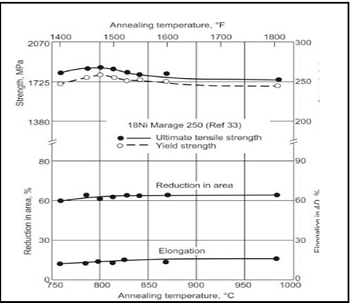
The graph shows the influence of solution-annealing temperature on the aged tensile properties of consumable vacuum-melted 18Ni Marage 250 steel. Heat treatment consists of solution annealing for half an hour at the indicated temperatures, air cooling, and then aging at 480 °C (900 °F) for three hours.
The solution-annealing temperature has only a small effect on the strength of the aged material. This behavior is graphically depicted in the graph. The data show that peak strength occurs with an 800 to 815°C (1475 to 1500°F) solution anneal, and strength is reduced up to 135 MPa (20 ksi) with higher and lower temperatures in the 760 to 980°C (1400 to 1800°F) range. Tensile ductility increases slightly with annealing temperatures from 760 to 815°C (1400 to 1500°F) and remains relatively unchanged with temperatures up to 980°C (1800°F).
Lower strength and ductility with solution-annealing temperatures from 760 to 800 °C (1400 to 1475 °F) are attributed to incomplete solution of hardening elements. The reduction in strength associated with solution-annealing temperatures above 815 °C (1500 °F) is attributed to coarsening of the grain/packet structure. This grain growth and the subsequent reduction in strength are minimized by boron contents between 0.001 and 0.003%.
Maraging steels are usually solution annealed at a given temperature for one hour. There could be a benefit to strength from shorter solution-annealing times; however, care must be taken to ensure complete solution of hardening elements. Therefore, one hour solution-annealing times are generally favored, and excessively long times are discouraged. Even boron-containing maraging steels will exhibit grain growth if exposed for more than 6 h at 955 °C (1750 °F).
Volume 4D, Heat Treating of Irons and Steels -> Heat Treated High-Alloy Steels ->Heat Treating of Maraging Steels -> Martensite Aging