Carnegie Mellon University, Pittsburgh, announces that its researchers have developed a copper-tin solder material that has twice the conductivity of conventional solders.
Known as “supersolder,” the material also demonstrates high elasticity, similar to that of rubber or other polymers. Also called compliance, this elastic property is important because the parts that the solder connects expand and contract when heated, often at varying rates between two parts of differing composition. Diminishing compliance is often the downfall of conventional solders, as they grow brittle over repeated use, degrading their ability to conduct heat over time.
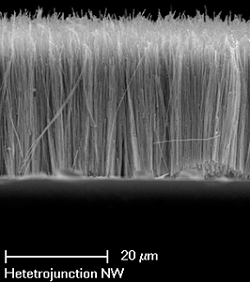
The product of a 2013 DARPA Young Faculty Award, supersolder is a thermal interface material (TIM) developed by Dr. Sheng Shen, associate professor of mechanical engineering at Carnegie Mellon, in collaboration with researchers from the National Renewable Energy Laboratory. Four years of work have resulted in the creation of a material that can fill the same role as conventional solders, but with twice the thermal conductance of current state-of-the-art TIMs. The photo shows supersolder viewed at 2500X magnification, revealing the thin layer of copper (the darker lower segment) and the tin nanowire array (the lighter upper segment).
“The nanowires are grown from a template, like a mold, using small pores,” says Prof. Shen. “It is chip technology using electroplating, grown one layer at a time, similar to coating an electrical cord by dipping it into electrolyte.”