RMIT University in Melbourne, Australia, announces that its researchers have developed a molten metal catalyst technique that can efficiently convert carbon dioxide from a gas into solid particles of carbon. Published in the journal Nature Communications, the research offers an alternative pathway for safely and permanently removing the greenhouse gas from our atmosphere.
RMIT researcher Dr. Torben Daeneke, an Australian Research Council DECRA Fellow, says that converting CO2 into a solid could be a more sustainable approach. “While we can’t literally turn back time, turning carbon dioxide back into coal and burying it back in the ground is a bit like rewinding the emissions clock,” says Dr. Daeneke “By using liquid metals as a catalyst, we’ve shown it is possible to turn the gas back into carbon at room temperature, in a process that’s efficient and scalable. While more research needs to be done, it’s a crucial first step to delivering storage of solid carbon.”
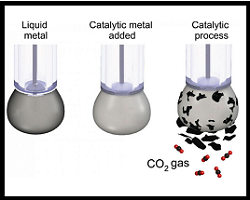
Lead author Dr. Dorna Esrafilzadeh, a Vice-Chancellor’s Research Fellow in RMIT’s School of Engineering, developed the electrochemical technique. The researchers designed a liquid metal catalyst with specific surface properties that made it extremely efficient at conducting electricity, while chemically activating the surface. The carbon dioxide is dissolved in a beaker filled with a liquid electrolyte and a small amount of the liquid metal, which is then charged with an electrical current. The CO2 slowly converts into solid flakes of carbon, which are naturally detached from the liquid metal surface, allowing the continuous production of carbonaceous solid.
Dr. Esrafilzadeh says the carbon produced could also be used as an electrode. “A side benefit of the process is that the carbon can hold electrical charge, becoming a supercapacitor, so it could potentially be used as a component in future vehicles. The process also produces synthetic fuel as a by-product, which could also have industrial applications.”
The paper is published in Nature Communications (“Room temperature CO2 reduction to solid carbon species on liquid metals featuring atomically thin ceria interfaces”, DOI: 10.1038/s41467-019-08824-8).