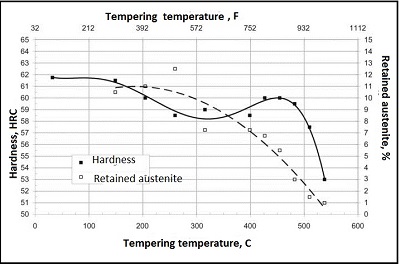
The graph (Figure 18) shows the effect of tempering temperature on the hardness and retained austenite content of Type 440C stainless steel austenitized at 1065°C (1950°F). To achieve maximum corrosion resistance, it should be tempered at lower temperatures, avoiding tempering near the secondary-hardening temperatures.
Very rapid quenching (oil or gas) is necessary to avoid grain boundary precipitation of chromium carbides, which also have an adverse effect on corrosion resistance. BG-42 typically is used in high-temperature applications where hot hardness (high-temperature hardness) and corrosion resistance are required. A typical thermal treatment designed for high-temperature applications for BG-42 is:
Austenitize 1115–1130°C (2040–2065°F) 30 min + 30 min/each additional inch of thickness, salt bath or in vacuum under partial pressure of argon;
Quench in oil to room temperature, or in salt to 565°C (1050°F), then AC to room temperature;
Snap temper 150°C (300°F) for one hour;
Subzero cool to −75°C (−100°F);
Double temper at 525°C (975°F) for two hours.
For more information, click on the link below (subscription required), then scroll down the Chapter Contents column on the left of the page, and click on “Special Purpose Through-Hardening Bearing Steels.”
https://dl.asminternational.org/handbooks/book/9/chapter/110017/Heat-Treatment-of-Bearings