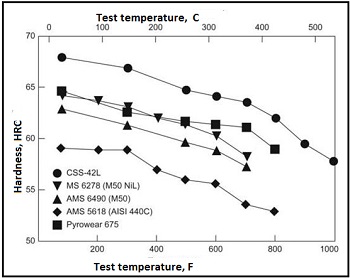
Several specialty carburizing steel grades have been developed for specific requirements involving high-temperature performance, fracture toughness, and/or resistance to oxidation and corrosion. These include grades such as M50NiL, CSS-42L (Carpenter Technology Corp.), and Pyrowear 53 and Pyrowear 675 (Carpenter Technology Corp.).
Figure 32 shows a comparison of fracture toughness and hot hardness characteristics of these alloys compared with through-hardening grades and other carburizing grades.
Pyrowear 53 is used in gear applications, but is not used extensively in bearing applications.
CSS-42L has excellent case properties (hardness, hot hardness, microstructure, and residual stress profile), but the inherent layer of retained austenite developed at the case and core interface prohibits considering this alloy for use in many bearing applications. Any transformation of the retained austenite region could cause unwanted dimensional changes in the bearing component. Dimensional stability is a critical characteristic of aerospace bearing components. Excessive size change can cause loss of internal clearance in the bearing and improper interference fit of inner ring bores to shafts.
M50NiL was developed as a low carbon carburizing version of M50 with 3.5% nickel added to control the microstructure. The Ni in NiL is for nickel, and the L is for low carbon. M50NiL bearings are used in many jet-engine bearing applications.
Pyrowear 675 is a carburizing corrosion-resistant steel with case corrosion-resistant properties similar to those of Type 440C, as well as excellent core toughness and hot hardness. It is used in many airframe control applications (rod ends, stud type track rollers, etc), as well as in jet engine applications.
For more information, click on the link below (subscription required). Then scroll down the Chapter Contents column on the left of the page, and click on “Special Purpose Carburizing Grades.”
https://dl.asminternational.org/handbooks/book/9/chapter/110017/Heat-Treatment-of-Bearings