Researchers from Advanced Micro Devices, Thermo Fisher Scientific, and the Fraunhofer Institute for Microstructure of Materials and Systems IMWS, presented a discussion of “Lock-In Thermography” (LIT) at the ASM International ISTFA 2019 conference in Portland, Oregon.
LIT is a technique for nondestructively localizing resistive opens and electrical shorts within packaged devices by detecting and analyzing defect-related thermal sources caused by the dissipation of electrical power.
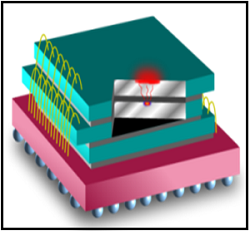
In this technique, the device under test is excited by periodically applying electrical power. The repetition frequency of the stimulation is the “lock-in frequency” of the measurement, necessary to perform “lock-in amplification.” Stimulation of a resistive defect that is located within a stack of multiple dies using the lock-in scheme, leads to a periodically occurring local heating. The resulting thermal signal can then be analyzed to laterally isolate the defect and to estimate its axial position for guiding subsequent physical failure analysis methods with the goal of uncovering the defect’s root cause.
The paper reported on the evaluation and validation of the method and presented case studies.
Title: Advanced 3D localization in Lock-In Thermography based on the analysis of the TRTR (Time-Resolved Thermal Response) received upon arbitrary waveform stimulation
Authors:
Dr. Sebastian Brand, Mr. Michael Kögel, Mr. Christian Grosse, Mr. Frank Altmann, Fraunhofer Institute for Microstructure of Materials and Systems IMWS, Halle, Germany
Ms. Bernice Zee, Ms. Qiu Wen, Advanced Micro Devices, Singapore
Mr. Brian Lai, Ms. Qingqing Wang, Dr. Jim Vickers, Mr. David Tien, Thermo Fisher Scientific, Fremont, California