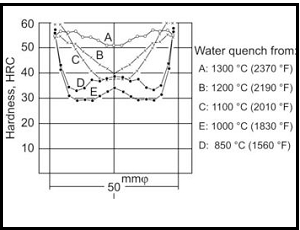
The quench hardenability of forged steels is increased by grain coarsening and higher dislocation density. Research has shown that control of factors such as forge finish temperature and quench temperature allow the optimization of hardness and microstructure.
The increase in hardenability permits better hardness uniformity than can be achieved in traditional quenched and tempered steels. As a result, lower-carbon steels such as S30-35C, S45C, and SMn420 can be used in certain applications in place of low-alloyed medium-carbon steels such as SCM 420, SCR 420, S55, 48, and 45C.
Moreover, the resulting full-hardenability low-carbon steels have permitted a simultaneous increase of both shock resistance and fatigue strength, and the advancement of induction heating technology has permitted a reduction of the tendency toward grain coarsening by reducing heating and holding times at the forging temperature.
For more information, click on the link below (subscription required). Then scroll down the Chapter Contents column on the left of the page, and click on “Definition and Purposes of Direct Forging and Heat Treatment.” Then scroll to Direct-Forge Quenching (DFQ) and Tempering Processes, and Figure 5.