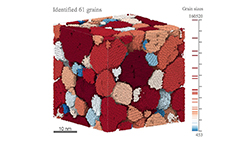
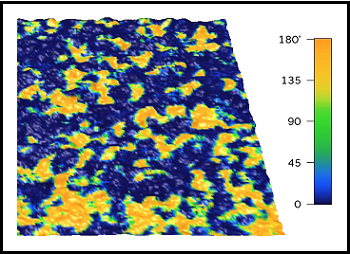
Researchers at the Center for Nanoscale Materials (CNM), a U.S. Department of Energy (DOE) Office of Science User Facility located at the DOE’s Argonne National Laboratory, have invented a machine-learning based algorithm for quantitatively characterizing, in three dimensions, materials with features as small as nanometers. Researchers can apply this pivotal discovery to the analysis of most structural materials of interest to industry.
“What makes our algorithm unique is that if you start with a material for which you know essentially nothing about the microstructure, it will, within seconds, tell the user the exact microstructure in all three dimensions,” said Subramanian Sankaranarayanan, group leader of the CNM theory and modeling group and an associate professor in the Department of Mechanical and Industrial Engineering at the University of Illinois at Chicago.
“For example, with data analyzed by our 3D tool,” said Henry Chan, CNM postdoctoral researcher and lead author of the study, “users can detect faults and cracks and potentially predict the lifetimes under different stresses and strains for all kinds of structural materials.”
In the past, scientists have visualized 3D microstructural features within a material by taking snapshots at the microscale of many 2D slices, processing the individual slices, and then pasting them together to form a 3D picture. Such is the case, for example, with the computerized tomography scanning routine done in hospitals. That process, however, is inefficient and leads to the loss of information. Researchers have thus been searching for better methods for 3D analyses.
The Argonne team successfully tested their algorithm with data obtained from analyses of several different metals (aluminum, iron, silicon, and titanium) and soft materials (polymers and micelles). These data came from earlier published experiments as well as computer simulations run at two DOE Office of Science User Facilities, the Argonne Leadership Computing Facility and the National Energy Research Scientific Computing Center. Also used in this research were the Laboratory Computing Resource Center at Argonne and the Carbon Cluster in CNM.
This machine-learning tool should prove especially impactful for future real-time analysis of data obtained from large materials characterization facilities, such as the Advanced Photon Source, another DOE Office of Science User Facility at Argonne, and other synchrotrons around the world.
This study, titled “Machine learning enabled autonomous microstructural characterization in 3-D samples,” appeared in npj Computational Materials.
************
Image – Machine-learning enabled characterization of 3D microstructure showing grains of various sizes and their boundaries. Courtesy of Argonne National Laboratory.
For more information:
Argonne National Laboratory