Engineers from Purdue University, West Lafayette, Ind., report that they have developed a laser treatment method that could potentially turn any metal surface into a rapid bacteria killer – just by giving the metal’s surface a different texture.
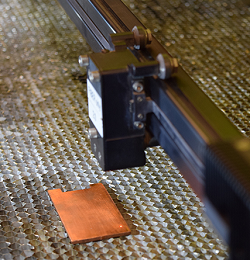
“We’ve created a robust process that selectively generates micron and nanoscale patterns directly onto the targeted surface without altering the bulk of the copper material,” says Rahim Rahimi, a Purdue assistant professor of materials engineering. The patterns produce a rugged texture that increases surface area, allowing more opportunity for bacteria to hit the surface and rupture on the spot. A YouTube video is available at https://youtu.be/3vFFdNXsoN0.
The laser-texturing has a dual effect: The technique not only improves direct contact, but also makes a surface more hydrophilic. For orthopedic implants, such a surface allows bone cells to more strongly attach, improving how well the implant integrates with bone. Due to the simplicity and scalability of the technique, the researchers believe that it could easily be translated into existing medical device manufacturing processes.
In a study published in the journal Advanced Materials Interfaces, the researchers demonstrated that this technique allows the surface of copper to immediately kill off superbugs such as MRSA.
The technique is not yet tailored to killing viruses such as the one responsible for the COVID-19 pandemic, which are much smaller than bacteria. Since publishing this work, however, Prof. Rahimi’s team has begun testing this technology on the surfaces of other metals and polymers that are used to reduce risks of bacterial growth and biofilm formation on devices such as orthopedic implants or wearable patches for chronic wounds.
The work was funded in part by Purdue’s School of Materials Engineering and the Wabash Heartland Innovation Network. This research was performed at the Birck Nanotechnology Center in Purdue’s Discovery Park.