A new design for light-emitting diodes (LEDs) developed by a team of scientists at the National Institute of Standards and Technology (NIST), Gaithersburg, Md., may hold the key to overcoming a light source’s long-standing efficiency limitation. The concept, demonstrated with microscopic LEDs in the lab, achieves a dramatic increase in brightness as well as the ability to create laser light—characteristics that could make it valuable in a range of large-scale and miniaturized applications.
The team, which includes scientists from the University of Maryland, Rensselaer Polytechnic Institute and the IBM Thomas J. Watson Research Center, published its work in Science Advances. Their device shows an increase in brightness of 100 to 1000 times over conventional tiny, submicron-sized LED designs.
“It’s a new architecture for making LEDs,” said NIST’s Babak Nikoobakht, who conceived the new design. “We use the same materials as in conventional LEDs. The difference in ours is their shape.”
Feeding an LED more electricity makes it shine more brightly, but soon the brightness drops off, making LEDs highly inefficient. This “efficiency droop” stands in the way of LEDs being used in a number of promising applications, from communications technology to killing viruses.
While their novel LED design overcomes efficiency droop, the researchers did not initially set out to solve this problem. Initially, the main goal was to create a microscopic LED for use in very small applications such as lab-on-a-chip.
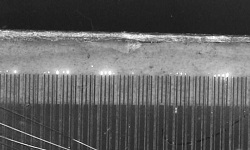
The team experimented with a new design for the part of the LED that shines. They built a light source out of long, thin zinc oxide strands they refer to as fins. The fin array looks like a tiny comb that can extend to areas as large as 1 centimeter or more.
Unlike flat, planar designs used in conventional LEDs, “we saw an opportunity in fins, as I thought their elongated shape and large side facets might be able to receive more electrical current,” Nikoobakht said.
Their novel design shines brilliantly in wavelengths between violet and ultraviolet, generating about 100 to 1000 times as much power as typical tiny LEDs do. Nikoobakht characterizes this result as a significant fundamental discovery.
The team made another surprising discovery as they increased the current. While the LED shone in a range of wavelengths at first, its comparatively broad emission eventually narrowed to two wavelengths of intense violet color. The explanation grew clear—their tiny LED had become a tiny laser.
A tiny laser would be critical for chip-scale applications such as chemical sensing, next-generation hand-held communications products, high-definition displays, and disinfection.
Image – A comb-like array of fin LEDs, some of which are glowing (bright spots at tips). Courtesy of B. Nikoobakht / NIST.
For more information:
National Institute of Standards and Technology