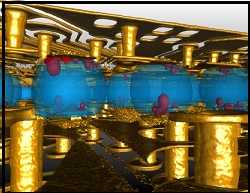
Researchers at King Abdullah University of Science and Technology (KAUST), Thuwal, Saudi Arabia, developed a fast and efficient way to make a carbon material that could be ideally suited to dissipating heat in electronic devices such as cooling the powerful electronics packed inside the latest smartphones. This versatile material could also have additional uses ranging from gas sensors to solar cells.
Many electronic devices use graphite films to dissipate heat generated by their electronic components. Although graphite is a naturally occurring form of carbon, heat management of electronics is a demanding application and usually relies on using high-quality micrometer-thick manufactured graphite films.
But the method used to make graphite films using polymer as a source material is complex and energy intensive. According to Geetanjali Deokar, a postdoc in Pedro Costa’s lab, who led the work at KAUST, the multistep process to make graphite films requires temperatures of up to 3200°C and cannot produce films thinner than a few micrometers.
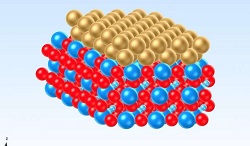
Deokar, Costa, and their colleagues developed a quick, energy-efficient way to make graphite sheets that are approximately 100 nm thick. The team grew nanometer-thick graphite films (NGF) on nickel foils using chemical vapor deposition (CVD) in which the nickel catalytically converts hot methane gas into graphite on its surface with CVD growth steps in just five minutes and reaction temperatures at 900°C.
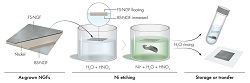
The NGFs, which could be grown in sheets of up to 55 cm2, grew on both sides of the foil. It could be extracted and transferred to other surfaces without the need of a polymer supporting layer, which is a common requirement when handling single-layer graphene films.
Cross-sectional transmission electron microscopy images of the NGF on nickel shows the thickness sits between commercially available micrometer-thick graphite films and single-layer graphene. And some sections were just a few carbon sheets thick.
Due to its flexibility, NGF could lend itself to heat management in flexible phones. These conducting, semitransparent NGFs could also find uses in other applications, for example, as components of solar cells or as a sensor material for detecting NO2 gas.
Image – Polymer-free wet chemical transfer process for NGFs grown on Ni foil. Courtesy of KAUST; Xavier Pita.
For more information:
King Abdullah University of Science and Technology