The U.S. Department of Energy (DOE) has a team of researchers exploring how a weld is put together atom by atom in order to unlock the key to making crack-free welds. The goal is to investigate the performance of welds used to build large thermal energy storage tanks at concentrating solar plants—facilities with vast networks of mirrors used to collect solar energy, some stretching several million square feet in size.
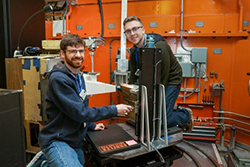
Graduate students at the Center for Welding, Joining and Coatings Research of Colorado School of Mines, Tim Pickle and Ben Schneiderman, used neutrons at the DOE’s Oak Ridge National Laboratory (ORNL) to improve their understanding of welds. They’re part of a project supported by DOE’s SunShot division and the National Renewable Energy Laboratory (NREL).
“What we’re trying to do is compare the differences in stress profiles between two manufacturing approaches, with and without post-weld heat treatment, used to create the storage tanks,” said Pickle. “We’re also trying to validate a finite element model that can be used by NREL and potential manufacturers to help them determine the best welding and post-weld heat treatment procedures to mitigate and find solutions to cracking problems.”
Specifically, the team is studying stress relaxation cracking—the susceptibility of welds to cracking over time due to factors such as internal stress and high temperatures.
The storage tanks, which are about 100 feet wide by 30 feet tall, are used to store molten salt material that is heated and liquified to store energy captured by solar panels. When energy is needed, the molten salt is pumped into a steam system that boils water, which then spins a turbine that generates electricity.
Essentially, a tank is made by rolling large plates of stainless steel into a cylinder. The ends are then fused together using seam welds, which require multiple layers of weld metal to fill the space in between the weld joints.
“When the welded areas of the wall joints go from room temperature to above 550 or 600 degrees Celsius, they develop stresses around the weld,” said Pickle. “We want to know if we can reduce the tensile stress by using a post-weld heat treatment before the weld goes into service, to extend the lifetime of the weld and mitigate the cracking mechanism we think is happening. To do that, we need to measure the residual stresses.”
Neutrons are the ideal tool for examining residual stress because they penetrate materials deeply to reveal atomic changes in the material’s internal structure. Using the HIDRA instrument (formerly the Neutron Residual Stress Mapping Facility) at ORNL’s High Flux Isotope Reactor, the team performed experiments on 2-inch-thick plates of 347 H stainless steel that were joined using a “40-pass” weld—a large weld consisting of 40 total individual weld beads to fuse the two ends together.
************
Image – Colorado School of Mines graduate student researchers Ben Schneiderman (left) and Tim Pickle using neutrons at ORNL’s High Flux Isotope Reactor to measure residual stress in welds used to make renewable energy storage tanks. Courtesy of ORNL/Genevieve Martin.
For more information: