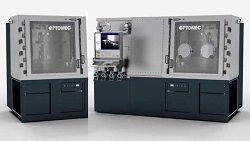
Optomec, Albuquerque, New Mexico, launched two new 3D metal Additive Manufacturing machines, the CS250 and the HC-TBR. The systems are based on Directed Energy Deposition (DED), a free form powder-based 3D metal printing technology that Optomec developed under the LENS trademark and continues to lead the market with more than 200 global installations.
Both machines offer value in terms of functionality, performance, flexibility, and pricing. They feature a 250 x 250 x 250 mm build volume, suitable for small part production and repair, including batch processing. They are available in 3- or 5-axis versions capable of simultaneous 5-axis coordinated motion for full free space building.
Their next-generation print head is capable of automatically changing the laser spot size and output power on the fly, to apply material faster to larger areas while creating fine features with lower heat input to thinner areas of the build.
They also have an optional inert processing capability optimized for building reflective and reactive alloys like copper, aluminum, and titanium, in addition to a variety of other common metals including steel, nickel, etc.
The CS250, designed for research, is an all-in-one system with up to four integrated powder feeders, enabling rapid alloy development and graded-material part creation. It is small enough to pass through a standard doorway, facilitating use in research labs. The base system pricing starts at under $300,000.
The HC-TBR machine is designed for high performance, high volume production applications, and includes the capability of automatically moving and processing titanium parts into and out of an inert atmosphere, a feature critical for high-quality metallurgy and plant safety.
For Additive Repair applications, such as production turbine blade restoration, the HC-TBR also includes an integrated vision system with proprietary AutoCLAD software that scans each part individually and uses pattern recognition to create a custom tool path and additive repair recipe, compensating for part-to-part variation while minimizing the heat input into the component.
The HC-TBR was designed for easy integration into automated work cells and includes automatic antechamber doors which can be loaded and unloaded robotically.
“The HC-TBR is the first machine capable of high volume production for reactive metals like aluminum and titanium,” commented Mike Dean, Optomec marketing director. “We’ve seen quite an increase in demand for these materials from our customers and expect the trend to continue as manufacturers move to lighter weight designs.”
Image – Optomec’s new CS250 and HC-TBR metal AM machines. Courtesy of Optomec.
For more information:
Optomec
www.optomec.com