Three researchers from Missouri S&T are part of a nationwide collaboration to synthesize inexpensive materials hard enough to stir two pieces of steel together and create some of the hardest materials ever produced. Department of Defense project will create AI-materials tools to design recipes for a new class of materials tailored to super-hard, high-temperature applications.
With funding from a five-year, $7.5 million grant through the U.S. Department of Defense’s Multidisciplinary University Research Initiative (MURI) competition, the researchers will also develop a suite of artificial intelligence-materials tools capable of designing similar materials on-demand with properties tailored to a wide range of applications.
Researchers at Duke University’s Center for Autonomous Materials Design are leading the project. In addition to the Missouri S&T team, the project includes researchers from Pennsylvania State University, North Carolina State University, and State University of New York at Buffalo.
The class of high-entropy materials derives enhanced stability from a chaotic mixture of atoms rather than relying solely on the orderly atomic structure of conventional materials. After first demonstrating this approach with carbides in 2018, the researchers plan to add borides into the irregular self-organized structures to produce extremely hard materials.
Testing these materials will require specialized equipment that can take elemental powders, heat them at several thousand degrees under high pressures (without melting them) for days, and then slowly let them cool. Once the project is complete, the researchers hope to not only have produced a super-hard high-entropy carbide-boride capable of friction stir welding steel, but to have devised a system for designing similar materials to fit other needs as well.
For more information: Missouri S&T
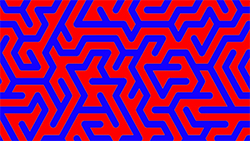
Image – A Tetris-like grid of high-entropy carbides (blue) and borides (red) is expected to produce super-hard materials that can literally stir two pieces of steel together. Image courtesy of Duke University.