MIT researchers have developed a technique to quickly determine certain properties of a material, like stress and strain, based on an image of the material showing its internal structure. The approach could one day eliminate the need for arduous physics-based calculations, instead relying on computer vision and machine learning to generate estimates in real-time. The researchers say the advance could enable faster design prototyping and material inspections.
Engineers spend lots of time-solving equations. They help reveal a material’s internal forces, like stress and strain, which can cause that material to deform or break. Such calculations might suggest how a proposed bridge would hold up amid heavy traffic loads or high winds.
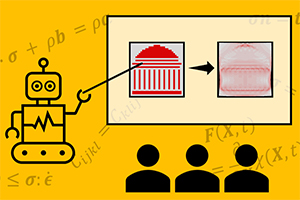
The researchers turned to a machine learning technique called a Generative Adversarial Neural Network. They trained the network with thousands of paired images—one depicting a material’s internal microstructure subject to mechanical forces, and the other depicting that same material’s color-coded stress and strain values. With these examples, the network uses principles of game theory to iteratively figure out the relationships between the geometry of a material and its resulting stresses.
That image-based approach is especially advantageous for complex, composite materials. Forces on a material may operate differently at the atomic scale than at the macroscopic scale. But the researcher’s network is adept at dealing with multiple scales. It processes information through a series of convolutions, which analyze the images at progressively larger scales.
The fully trained network performed well in tests, successfully rendering stress and strain values given a series of close-up images of the microstructure of various soft composite materials. The network was even able to capture singularities, like cracks developing in a material. In these instances, forces and fields change rapidly across tiny distances.
In addition to saving engineers time and money, the new technique could give nonexperts access to state-of-the-art materials calculations. Once trained, the network runs almost instantaneously on consumer-grade computer processors. That could enable mechanics and inspectors to diagnose potential problems with machinery simply by taking a picture.
For more information: MIT News