Computer scientists at Loughborough University, London, have developed a new tool that uses artificial intelligence to analyze images of wind turbine blades to locate and highlight areas of defect.
Demand for wind power has grown, and with it the need to inspect turbine blades and identify defects that may impact operation efficiency. From visual thermography to ultrasound, a wide range of blade inspection techniques have been trialed, but all have displayed drawbacks.
Most inspection processes still require engineers to carry out manual examinations that involve capturing a large number of high-resolution images. Such inspections are not only time-consuming and impacted by light conditions, but they are also hazardous.
The new tool, which has received support and input from software solutions provider Railston & Co Ltd, has been trained to classify defects by type, such as crack, erosion, void, and ‘other’, providing potential to lead to faster and more appropriate responses.
The proposed tool can currently analyze images and videos captured from inspections that are carried out manually or with drones.
Research leads Dr. Georgina Cosma and Ph.D. student Jiajun Zhang trained the AI system to detect different types of defects using a dataset of 923 images captured by Railston & Co Ltd, the project’s industrial partner.
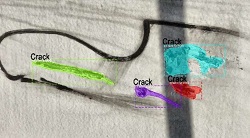
Using image enhancement and augmentation methods, and AI algorithms (namely the Mask R-CNN deep learning algorithm), the system analyses images then highlights defect areas and labels them by type.
After developing the system, the researchers put it to the test by inputting 223 new images. The proposed tool achieved around 85% test accuracy for the task of recognizing and classifying wind turbine blade defects.
Along with the results, published in the Journal of Imaging, authors propose a new set of measures for evaluating defect detection systems, which is much needed given AI-based defect detection and existing systems are still in their infancy.
“Defect detection is a challenging task for AI, since defects of the same type can vary in size and shape, and each image is captured in different conditions (e.g. light, shield, image temperature, etc.). The images are pre-processed to enhance the AI-based detection process and currently, we are working on increasing accuracy further by exploring improvements to pre-processing the images and extending the AI algorithm,” says Zhang.
Jason Watkins, of Railston & Co Ltd, says “AI has the potential to transform the world of industrial inspection and maintenance. As well as classifying the type of damage we are planning to develop new algorithms that will better detect the severity of the damage as well as the size and its location in space. We hope this will translate into better cost forecasting for our clients.”
Future research will further explore using the AI tool with drones in a bid to eliminate the need for manual inspections. Researchers will also train the system to detect the severity of defects. They are also hoping to evaluate the performance of the tool on other surfaces.
Image – Crack detection using the AI technology. Courtesy of Loughborough University.
For more information:
Loughborough University
http://www.lboro.ac.uk/