Metal injection molding (MIM) is a metalworking process in which finely powdered metal is mixed with binder material to create a feedstock that is then shaped and solidified using injection molding. It is similar to the conventional PM process but different in some important areas. This leads to new considerations for the design of MIM parts when compared with conventional PM. It also offers many new advantages that can be used to produce cost-effective, high-performance parts.
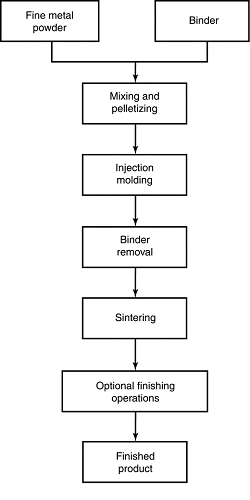
An overview of the process is shown in the figure. Metal powder is mixed with a specially designed plastic binder that often has thermoplastic properties. The mixture is often produced in the form of pellets, which makes it easier to handle and provides a uniform composition. The mixture (feedstock) can contain up to 50 vol% binders. The feedstock is heated to the plastic range and injected into a mold under pressure. Mold temperature is such that the part becomes harder and can be ejected from the mold with excellent green strength. The part is treated to remove the plastic binder. Techniques used to remove the binder include solvent extraction, controlled heating to volatilize the binder, and catalytic debinding. The resulting part is very fragile and must be treated carefully before sintering. The part is sintered similarly to conventional PM parts, except that the lower part density before sintering leads to large amounts of shrinkage, up to 25% or more.
For more information, click on the link below (subscription required). Then scroll to Figure 4.
Joseph W. Newkirk, Heat Treatment of Powder Metallurgy Steels, Heat Treating of Irons and Steels, Vol 4D, ASM Handbook, Edited By Jon L. Dossett, George E. Totten, ASM International, 2014, p 253-273, https://doi.org/10.31399/asm.hb.v04d.9781627081689.