Blasting abrasives include angular chilled iron grit, alumina, crushed flint, crushed garnet, silicon carbide, and crushed slag. Maintaining the right grit-size distribution requires that blasting equipment is capable of screening and dust collection during blasting. Grit size should be the smallest that will produce the desired surface characteristics.
Angular chilled iron grit is practical for use with centrifugal blasting equipment in preparing surfaces for flame spraying. Chilled iron grit has hardnesses up to 60 to 62 HRC and can be used on substrate materials as hard as 40 to 45 HRC. Chilled iron is often called steel grit, but steel grit has a hardness of only 43 to 48 HRC and is too soft for most blasting. Steel grit becomes dull and does not produce the sharply defined surface details needed for proper bonding of sprayed coatings. Chilled iron grit stays sharp longer, and some fracturing occurs during use to produce new, sharp cutting edges.
Alumina (Al2O3) grit works well in blasting cabinets of both designs. The specific gravity of alumina is just over half that of chilled iron, so that this type of abrasive is readily picked up by the suction feed and is effectively accelerated through the blasting nozzle. The rate of breakdown is not excessive when used at moderate air pressures.
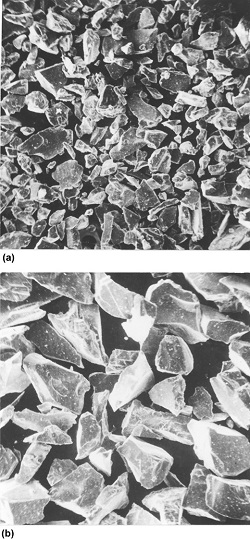
Brown, fused alumina is the more commonly used grit medium and is extremely hard (>9 on the Mohs scale). When properly crushed, it has sharp cutting edges. Alumina grains of 240- and 150-mesh size are shown in the image. Alumina grit is also used for hard surfaces (>45 HRC) and on nonferrous materials where embedded steel grit could result in corrosion problems.
Crushed flint for blasting is available in all mesh sizes. Some users feel that crushed flint is superior to ordinary silica sand. It is very clean, and the particles are extremely angular and sharp. Flint is, of course, a form of silica, and proper precautions against silicosis must be taken.
Crushed garnet is available in several areas. The composition of garnet varies widely, and some grades may contain free silica and thus mandate respiratory protection. As may be expected, the breakdown rate also varies with garnets from different sources. Some grades are almost dust-free when blasting, while others produce nearly as much dust as silica sand.
Silicon carbide (SiC) is also available in many mesh sizes. However, for coating applications where high temperatures are encountered, it is not recommended because of its reactivity with various substrates and coating materials.
Crushed slag is a black, glassy grit made from the slag produced by certain types of furnaces. Ordinarily, it contains no free silica, but this should be verified with the supplier. Crushed slag is usually angular and well graded.
Image – Fig. 7 – Aluminum oxide (Al2O3) particles. Original magnification: 130x. (a) 240 mesh. (b) 150 mesh
This information is from ASM Handbooks Online, Vol. 5A: Thermal Spray Technology, Coating Structures, Properties, and Materials. To find this information (subscription required), click on the link below and scroll down to Figure 7.