Lawrence Berkeley National Laboratory, Berkeley, Calif., has discovered a new and practical path towards manufacturing titanium with high ductile strength. The technique relies on low-temperature cryoforging to create nanotwinned titanium, which has 30% more ductility than normal titanium.
To create nanotwinned titanium, the research team used a simple technique, cryoforging–manipulating the structure of the metal at ultra-low temperatures. The technique starts with a cube of very pure (more than 99.95%) titanium placed into liquid nitrogen at minus 321 degrees Fahrenheit. While the cube is submerged, compression is applied to each axis of the cube. Under these conditions, the structure of the material begins to form nano twin boundaries. The cube is later heated to 750 degrees Fahrenheit to remove any structural defects that formed in between the twin boundaries.
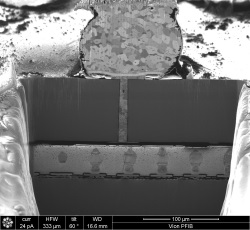
The researchers put the newly formed material through a series of stress tests and used the Molecular Foundry’s electron microscopes to uncover the source of its unique properties. During these tests, they found that nanotwinned titanium had better formability because it has the ability to both form new nano twin boundaries and undoes previously formed boundaries, both of which help with deformation. They tested the material to extreme temperatures up to 1112 degrees Fahrenheit, as hot as flowing lava, and found it maintained its structure and properties, demonstrating the versatility of the material.
Read further here.