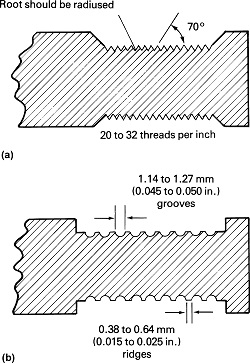
Macroroughening is usually accomplished by machining grooves or threads into the surface to be sprayed. Typically, rough-machined surfaces are also grit blasted prior to spraying. Surfaces roughened to this magnitude are often used for thick coatings to restrict shrinkage stresses and to disrupt the lamellar pattern of particle deposition in order to break up the shear stresses parallel to the substrate surface. Caution should be used with this technique. Threading reduces cross section and can affect load capability and increase fatigue.
It is always good practice to begin thermal spraying of a component as soon as possible after completion of surface preparation. Freshly exposed clean metal is metallurgically active and readily susceptible to contamination and oxidation. Fingerprints or contact with foreign materials may severely affect coating adhesion. If a freshly prepared surface must be stored before spraying, it should be kept covered and stored in a clean, dry area with the temperature maintained above the dewpoint, but preferably within two hours depending on substrate materials.
Image – Examples of surface preparation by threading or grooving. Adapted from T.F. Bernecki, Ed., Thermal Spray Research and Applications, Proc. Third National Thermal Spray Conf. May 20–25, 1990 (Long Beach, CA), ASM International, 1991
This information is from ASM Handbooks Online, Vol. 5A: Thermal Spray Technology, Coating Structures, Properties, and Materials. To find this information (subscription required), click on the link below and scroll down to Figure 8.
https://dl.asminternational.org/handbooks/book/12/chapter/134972/Introduction-to-Coating-Design-and-Processing