A new study led by University of Minnesota Twin Cities researchers shows why liquid droplets have the ability to erode hard surfaces, a discovery that could help engineers design more erosion-resistant materials.
Using a newly developed technique, published in Nature Communications, the researchers measured quantities such as the shear stress and pressure created by the impact of liquid droplets on surfaces, a phenomenon that has only ever been studied visually.
Researchers have studied the impact of droplets for years, from the way raindrops hit the ground to the transmission of pathogens such as COVID-19 in aerosols. It’s common knowledge that slow-dripping water droplets can erode surfaces over time. But why can something seemingly soft and fluid make such a huge impact on hard surfaces?
In the past, droplet impact has only been analyzed visually using high-speed cameras. The University of Minnesota researchers’ new technique, called high-speed stress microscopy, provides a more quantitative way to study this phenomenon by directly measuring the force, stress, and pressure underneath liquid drops as they hit surfaces.
The researchers found that the force exerted by a droplet actually spreads out with the impacting drop instead of being concentrated in the center of the droplet. The speed at which the droplet spreads out exceeds the speed of sound at short times, creating a shock wave across the surface. Each droplet behaves like a small bomb, releasing its impact energy explosively and giving it the force necessary to erode surfaces over time.
Besides paving a new way to study droplet impact, this research could help engineers design more erosion-resistant surfaces for applications that must weather the outdoor elements. Future plans to expand this research will study how different textures and materials change the amount of force created by liquid droplets, to see if the amount of shear stress of rain droplets can be reduced, allowing special surfaces to be designed that can mitigate stress.
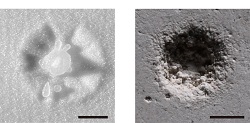
Image – The impact droplets can make on a granular, sandy surface (left) versus a hard, plaster (right) surface. Courtesy of: Cheng Research Group, University of Minnesota.
For more information:
University of Minnesota
University of Minnesota video demonstrating in slow motion how a water droplet impacts a sandy surface
https://www.youtube.com/watch?v=6n4lsx5aXEQ&feature=emb_logo