Physicists at the University of Nebraska–Lincoln recently teamed up to craft the first magneto-electric transistor, a new spin on the transistor that could help feed the world’s ever-growing appetite for digital memory while slicing up to 5% of the energy from its power-hungry diet.
Along with curbing the energy consumption of any microelectronics that incorporates it, the team’s design could reduce the number of transistors needed to store data by as much as 75%, leading to smaller devices. It could also lend microelectronics steel-trap memory that remembers exactly where its users leave off, even after being shut down or abruptly losing power.
As silicon-based microchips are nearing their practical limits, the semiconductor industry is investigating and funding every promising alternative it can. “The traditional integrated circuit is facing some serious problems,” said Dowben, Charles Bessey Professor of physics and astronomy at Nebraska and co-author of the paper on the work that graced the cover of the journal Advanced Materials.
“We’re getting to the point where we’re going to approach the previous energy consumption of the United States just for memory (alone). And it doesn’t stop. So you need something that you can shrink smaller, if possible. But above all, you need something that works differently than a silicon transistor, so that you can drop the power consumption, a lot.”
Typical silicon-based transistors in random-access memory—the form that most computer applications rely on—require a constant supply of power to maintain the binary states that indicate a buildup or absence of electron charges and are encoded as a 1 or 0.
Rather than depend on electric charge as the basis of its approach, the team turned to spin: a magnetism-related property of electrons that points up or down and can be read, like electric charge can, as a 1 or 0.
Electrons flowing through graphene, an ultra-robust material just one atom thick, can maintain their initial spin orientations for relatively long distances—an appealing property for demonstrating the potential of a spintronic-based transistor.
Controlling the orientation of those spins using substantially less power than a conventional transistor was a much more challenging prospect.
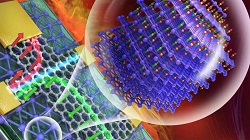
To do it, the researchers underlaid the graphene with chromium oxide, a magneto-electric material. The spins of the atoms at its surface can be flipped from up to down, or vice versa, by applying a meager amount of temporary voltage.
With a positive voltage applied, the spins of the underlying chromium oxide point up, ultimately forcing the spin orientation of the graphene’s electric current to veer left and yield a detectable signal in the process. Negative voltage flips the spins of the chromium oxide down, with the spin orientation of the graphene’s current flipping to the right and generating a clearly different signal.
“This potentially gives you huge fidelity at very little energy cost. All you did was apply voltage, and it flipped,” Dowben said.
Dowben’s team made several essential advances. There was the realization that magneto-electric materials could prove a workable approach. The identification of chromium oxide. The modification of it, both to control its spin with voltage instead of power-draining magnetism, but also to ensure it would operate well above room temperature—because, as Dowben put it, “If you’re going to compete with the semiconductor industry, it can’t just work in Nebraska in the winter. It has to work in Saudi Arabia in the summer.” Then there were the theory-backed computer simulations and multiple early-stage prototypes.
There are many alternative materials to graphene that share its one-atom thickness with properties better suited to a magneto-electric transistor. The race to overlay chromium oxide with those other 2D candidates is already on.
“Now that it works, the fun begins, because everybody’s going to have their own favorite 2D material, and they’re going to try it out,” Dowben said. “Some of them will work a lot, lot better, and some won’t. But now that you know it works, it’s worth investing in those other, more sophisticated materials that could.”
Image – A nanoscale rendering of two materials, graphene (gray) and chromium oxide (blue), that collectively allowed researchers from Nebraska and Buffalo to fabricate a new type of transistor. The red and green arrows represent spin, a magnetism-related property of electrons that can be read as a 1 or 0. Courtesy of: Advanced Materials / John Wiley & Sons, Inc.
For more information:
University of Nebraska