In addition to the effects of particles in the periphery of the spray stream resulting from poorly classified materials or non-optimized process parameters, consideration should be given to particles in the spray stream and how variations in the degree of melting and velocity affect coating structure.
Particles in the center of the spray pattern may include one or all of the following states on impact:
-
Fully molten, or just above the material melting temperature
-
Superheated, well above the melting temperature and perhaps close to the vaporization point
-
Semimolten, with the outside liquid but the core still solid
-
Molten then resolidified while in flight before impact
-
Under- and over-accelerated particles
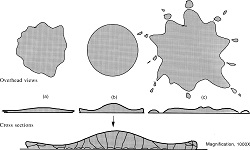
Fully melted particles at or just above the material melting point arrive at the substrate, impact, flow, and flatten as in the image. Particulate material spreads and cools rapidly as heat is conducted into the substrate. The classic lamellar splat morphology is thus achieved, and can be seen in the image (b). Lamellar particle thickness depends on particle velocity, particle temperature, substrate temperature, and other minor factors.
Superheated particles may splash on impact, sending out fine droplets radially that can end up in the coating as debris as in the image (c). Debris formed from splatter differs from debris produced in the jet, in that splatter lodges in the coating, building up at the first ridge that stops its radial travel. Air blasting does not remove splatter debris.
Superheating is a condition that generally should be avoided, in that it produces fumes, oxidation, and lowered deposition efficiency. Particles that resolidify in flight after having been melted may either not deposit or they may appear as embedded unmelted particles, usually with clearly discernible oxide layers on the particle surfaces as in the image (a).
Effect of the degree of particle melting at or just before impact on shape and coating structure. (a) Particle is heat softened or beginning to re-solidify. At impact, it does not flow out and begins to lift at the edges. (b) Properly melted particle impacts and flows to form a well-bonded classical lamellar splat shape. (c) Superheated particle impacts and splashes, creating debris, satellites, and dusting.
During development and as a quality-control measure, sprayed coatings should be examined metallographically in cross section to see these effects.
This information is from ASM Handbooks Online, Vol. 5A: Thermal Spray Technology, Coating Structures, Properties, and Materials. To find this information (subscription required), click on the link below and scroll down to Figure 17.
https://dl.asminternational.org/handbooks/book/12/chapter/134972/Introduction-to-Coating-Design-and-Processing