A camera system on the exterior of the International Space Station (ISS) will be snapping images of more than a dozen different material samples for the next six months. The mission is to gather detailed information that will help researchers determine how and why the harsh conditions of space affect these materials. Among the issues to be studied are color changes that may indicate the degradation caused by exposure to the environment in space.
A key goal of the research will be to correlate the color changes that occur under low-Earth orbital (LEO) exposure with variations in the materials’ properties—such as structural strength, chemical composition, and electrical conductivity—to determine how these spectral changes might allow scientists and engineers to visually assess deterioration. The LEO space environment exposes materials to the damaging effects of atomic oxygen, ultraviolet radiation, and high-energy electrons.
We want to know not only how space affects materials, but also why that happens,” said Elena Plis, a senior research engineer at the Georgia Tech Research Institute (GTRI) who is leading the multi-organization research team. “For instance, we know that a commonly used material from DuPont, Kapton polyimide film, is subject to changes in its conductivity in space, but we want to know why, how we might prevent that, or how we can use it to our benefit.
Regularly photographing the materials in both visible and infrared spectral ranges will provide a dynamic record of what happens with optical properties in space, improving upon the knowledge that has often been limited to measurements before and after space exposure. The research team will extensively analyze the materials returned to Earth to better understand how space degradation may affect other material properties and use this information for long-term space mission planning.
“I’m interested in the dynamics of damage caused to materials in space,” explained Plis. “Up until now, we have generally only had two data points for assessing the effects of space: the pristine materials that we launch, and the cumulative effects we can see when materials are returned. The uniqueness of this experiment is in letting us watch the damage occur over time.
Material samples were installed on the exterior of the ISS using a robotic arm and will be retrieved in the same way in about six months. The samples will be placed on three different faces of the ISS to receive preferential exposures to atomic oxygen, ultraviolet radiation, and high-energy electrons. The samples were delivered to the ISS by a SpaceX Dragon cargo spacecraft that launched on July 16.
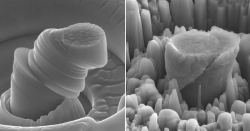
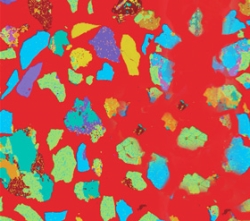
The samples, which are one-inch squares, are expected to be returned to Earth next spring. The materials flown in space will be examined in detail to understand the degradation and compared to identical samples subjected to simulated space conditions in the laboratory. In all, the samples will be subjected to 10 different characterization techniques, including atomic force microscopy, optical characterization of reflection and absorptance, and measurements of electrical charge transfer.
Image – Elena Plis, a Georgia Tech Research Institute (GTRI) senior research engineer, takes SEM measurements of materials being evaluated as part of the Materials International Space Station Experiment (MISSE)-16 program.
************
For more information:
Georgia Institute of Technology