The Fraunhofer Institute for Material and Beam Technology IWS in Dresden, Germany, developed a laser “LIGHTblast” technology to clean and structure surfaces more precisely, quickly, cost-effectively and in environmental friendlier ways than conventional systems. The technology is being transferred to the semiconductor manufacturing, automotive supply and other industries.
The Fraunhofer IWS researchers see considerable ecological and economic potential: “This is like sandblasting at the speed of light,” explains Dr. Patrick Herwig, who heads the Laser Cutting Group at the institute. “We are thus enabling industry to process equipment and components faster, more environmentally friendly and cleaner than before. Considering the entire production chain, our process is less expensive than classic sandblasting when used in series production. We are certain that laser technology will pay off for companies.”
Fraunhofer IWS is currently preparing initial application examples with various end users. Laser systems could soon replace sandblasting systems step by step there.
The market potential is considerable. The number of industries using classic sandblasting systems is increasing. Not only do they remove any contamination from a wide variety of components, but they also roughen them in a defined manner prior to coating, thus optimizing the result of the coating process. Occasionally, sand particles are embedded into the treated surface, which remain as a defect even after intense cleaning. In conventional processes, a jet of compressed air accelerates sand at high speed onto the target surface. The sharp-edged sand particles tear away parts of the surface, causing the sharp edges to wear away and mix with the resulting dust. With each use, the blasting medium contaminates more and steadily round grinds. The process result continuously deteriorates. Ultimately, the mixture must be disposed of as special waste, which pollutes the environment and causes additional costs.
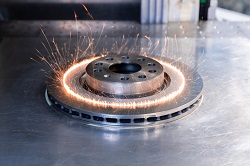
The process uses high-energy light instead of sand grains, performing cleaning and roughening significantly faster than conventional processes and should result in lower operating costs in series production. The process can also be automated more easily with positive effects on quality, process control and occupational safety. In addition, the system works much more precisely than a sandblasting system, as a laser beam with a diameter of less than 50 micrometers (i.e. thousandths of a millimeter) replaces a particle stream several centimeters wide. How rough the surface ends up can also be very finely adjusted with the new method.
Many pre- and post-processing steps are eliminated: The light-based processing does not require any chemicals for cleaning. The laser blasting system precisely processes only the desired surfaces, consuming neither sand nor material for masking and thus saving hazardous waste and adhesive tape waste. The laser beam vaporizes parts of the surface, the expanding vapor carries away solid components and also achieves a defined roughness.
Several industrial companies have already recognized these and other advantages of light sandblasting. They now want to gradually transfer the technology into manufacturing practice together with the Fraunhofer researchers. For example, Fraunhofer IWS and a partner are further developing the process to structure hard material coatings by means of laser technology and to decisively improve the finishing process with regard to costs and environmental compatibility.
In general, the new method can be applied wherever components need to be cleaned, pre-structured or roughened for subsequent coating. Further development steps are planned for this purpose.
LIGHTblast at a Glance
- 100 times faster than known microstructuring with processing speeds of up to 10 cm²/s
- Simple substitution through use of identical media connections as for sandblasting system
- Avoidance of blasting media and masking prevents component contamination, waste and operating costs
- Definition of surfaces to be processed via CAD at the click of a mouse
- Roughness precisely selectable from Rz= 2 µm to 200 µm.
Image – Sandblasting at the speed of light: Fraunhofer IWS uses high-energy light instead of sand grains to clean and roughen – for example the surface of brake discs. For this purpose, researchers developed a laser-based process that realizes cleaning and structuring tasks significantly faster than conventional processes and should result in lower operating costs in series production.
For more information:
Fraunhofer
https://www.iws.fraunhofer.de/en/